AI writes the draft. A human reviews the page. Here is the checklist.
Most agencies use AI to write the content, then stop short of having a human review it. Human review is extremely time-consuming and takes a deep understanding of the client's website and goals. This is the actual standard we are held to, printed in public so you can hold us to it.

Sources
Key takeaways: human-verified AI content
- Who writes the content? AI writes the first draft. A senior marketer then edits it against your own material and signs it before it publishes.
- What is the eight-point content check? Client-specific facts, verified figures, working links, author box, trust signals, schema, structure, and a filler sweep.
- Why publish the standard at all? So you can check our work against it. Saying "a human reviews every page" is easy; a printed checklist gives you eight specific points to hold us to on every page we publish.
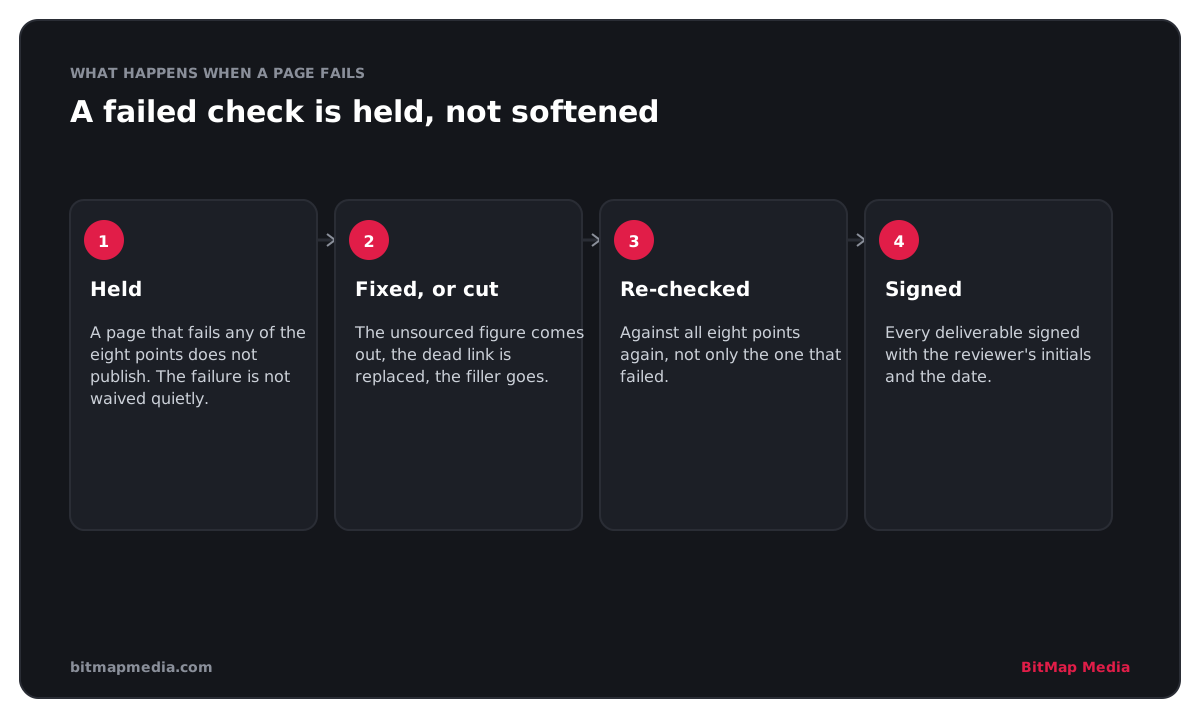
- What happens if a page fails? It is held. A failed check is not softened or waived quietly; it is fixed, or you are told what is missing and who has to supply it.

What is the eight-point content check?
Eight tests every page must pass before it publishes. Among them: a client-specific fact in every section, a first-hand detail no competitor could publish, filler and hedges cut, every date and figure sourced and verified, every link checked live, and an author box, updated date and matching schema. The full list follows.
The eight-point check is the same for every page.
- A client-specific fact in every section. If a competitor could publish the section unchanged, it fails. We cut. We do not pad.
- A first-hand detail no competitor could publish. Drawn from your own material, never invented and never widened beyond what it actually says.
- Filler and hedges cut. If deleting a sentence loses no information, the sentence goes.
- Every date and figure sourced and verified. Anything unsourced comes out. It does not get softened into a vaguer claim.
- Every link checked live. Internal and external, none to redirects, none to your competitors.
- Author box, updated date and matching schema. What the code claims and what the visitor sees have to agree.
- Your real selling points survived the edit. A page about your business that carries none of them has been edited into a generic article.
- Structure and standards. One H1, question headings with answers underneath, real lists, honest Rank Math score.
What happens when a page fails?
It is held, not softened and not published with a note to fix it later. It comes back to us, or to you with a plain statement of what is missing and who has to supply it.
It is held. Not softened, not waived quietly, not published with a note to fix it later. A held page comes back to us, or comes back to you with a plain statement of what is missing and who has to supply it. The value of a published standard is that it is inconvenient sometimes; a checklist that never holds anything up is decoration.
A page that fails the eight-point check does not publish.
Why do we publish our human-verified AI content standard?
Because "human reviewed" is easy to say and hard to check. Without a written standard, a buyer has no way to know what the human actually looked at before the invoice arrives.
Printing the checklist is the only version of the claim you can test. If a page we published fails one of these eight points, you have something concrete to point at, and we have nowhere to go.
That is the reason human-verified AI content needs a written standard.
What this is not
It is not a promise that AI wrote nothing. It did, and pretending otherwise would be its own kind of dishonesty.
It is not a claim that the check makes content rank. It makes content accurate, specific and structured, which is what ranking and citation are built on, but it is not a substitute for the search work itself.
Score your current pagesHuman review is the part we add, and the part we sign.
Questions about the standard
Is the content on my site written by AI?
The first draft is. Then a senior marketer edits it against your own material, checks it against eight points and signs it. What publishes is not what the model produced, and the difference is the part you are paying for.
Why use AI at all if a human rewrites it?
Because it removes the blank page and the slow first pass, which is where most agency time went. The judgment, the client-specific facts and the editing are where a human actually adds value, and that is where ours goes now.
What does NO AI SLOP actually mean in practice?
No filler phrases, no hedging that says nothing, no paragraph that any competitor could publish unchanged. If deleting a sentence loses no information, the sentence goes. It is a deletion standard as much as a writing one.
Who is the senior marketer signing it?
A member of our editorial team with decades in the field. Under Quiet Client we keep our own people off the public site the same way we keep our clients off it, but you deal with the same named person throughout your project.
Can I see the check for my own pages?
Yes. The eight-point content result for each page is available to you, including anything that was marked as not applicable and why.
What if I disagree with an edit?
You win. It is your business and your voice. We will tell you plainly when we think a change costs you something in search, then do it your way and note it.
Does the standard apply to short content too?
Yes. A meta description, a schema FAQ answer and an audit recommendation go through the same bar. Generic short copy is exactly as much of a miss as generic body copy, and easier to let slide.

Marketers with decades across print, TV, direct mail, email, web, video and CRM. Updated 10-30-2026. About the team