Generative engine optimization: make your facts safe to quote.
Generative engine optimization is facts written to survive being lifted out of context, entity pages that tell the engines exactly who you are, and the citation kit that ties it together. Included at the published price.
Check your AI visibility free
Sources
Key takeaways
- What is generative engine optimization? Writing and structuring facts so a generative engine such as ChatGPT or Gemini can quote them accurately out of context, and making your business a clear entity it can recognize.
- How is GEO different from AEO? AEO is about the shape of the answer on the page. GEO is about whether the facts survive being lifted, and whether the engine knows who you are across the whole web.
- Can you buy your way in? No. There is no ad slot in an AI answer today. Citation is earned through ranking, structure, clarity and being mentioned on sources the engines already read.
- What does it cost? GEO is included in every build, uplift and Monthly Care & SEO plan at the published price. There is no separate GEO fee.
What is generative engine optimization?
Generative engine optimization is the work of making your facts quotable by an AI that writes its own answer. The engine is not showing your page. It is reading it, deciding whether the facts on it are clear and trustworthy, and then writing a sentence of its own that may or may not name you.
That shifts what matters. A page can rank well and still be useless to a generative engine, because its facts are vague, scattered across a collapsed widget, or written in a way that falls apart the moment a sentence is separated from the rest of the page.
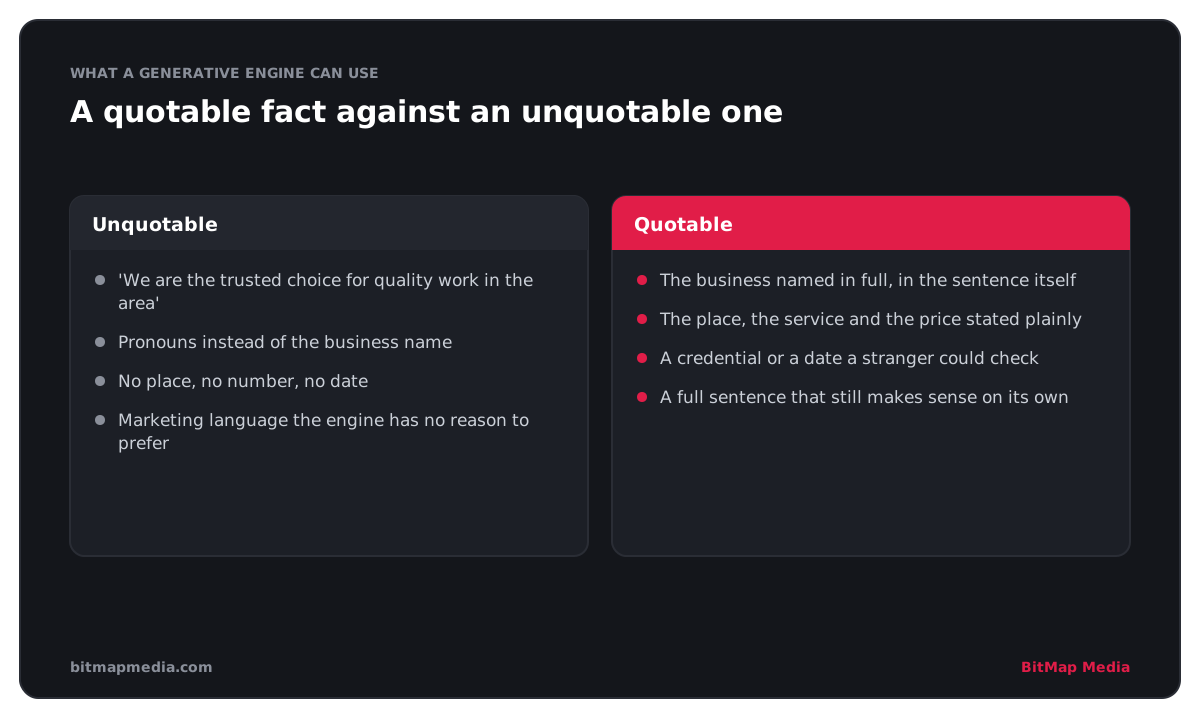
What makes a fact quotable to a generative engine
It names the subject
The business, the service and the place stated in full. No "we", no "our team", no "the area" standing in for something the reader already knows, and the engine does not.
It survives on its own
Lift the sentence out of the page, and it is still true and still attributed. That is the test we apply before a page goes live.
It is specific
A number, a place, a credential, a date. Vague claims are unquotable, and an engine that cannot quote you will quote a competitor who was specific.
It is in the HTML
Server-rendered, not injected by JavaScript and not hidden behind a tab or accordion the crawler may never open.
It agrees with itself
The same address, the same hours and the same service names everywhere. Contradictions across your own pages make the whole set less trustworthy.
It is backed by schema
Organization, Person, Service and LocalBusiness markup confirming in code what the page says in prose.
The entity problem most sites have
Before an engine can cite you it has to be confident about who you are. Most small business sites never answer that question in one place: the name varies, the address differs from the one in the directories, the owner is a photo without a name, and nothing in the code ties it together.
- An entity page that states the business, its location, its services and its people in plain sentences
- Organization and Person schema with sameAs links to the profiles that corroborate it
- Name, address and phone consistent across the site, the Business Profile and the directories
- llms.txt and a Master FAQ at the root, so a crawler has one obvious place to start
- Author boxes with real credentials on the pages that make claims
What we will not claim about generative engine optimization
There is no ad slot in an AI answer today, no submission form that guarantees a citation, and no way to make an engine quote you on demand. Anyone selling that is selling something else. What can be influenced is eligibility: ranking first, facts written to be lifted, an entity the engine can resolve, schema that validates, and indexing in both Google and Bing. We work those, agree one measurable number at kickoff, and report the movement every month.
See what it costs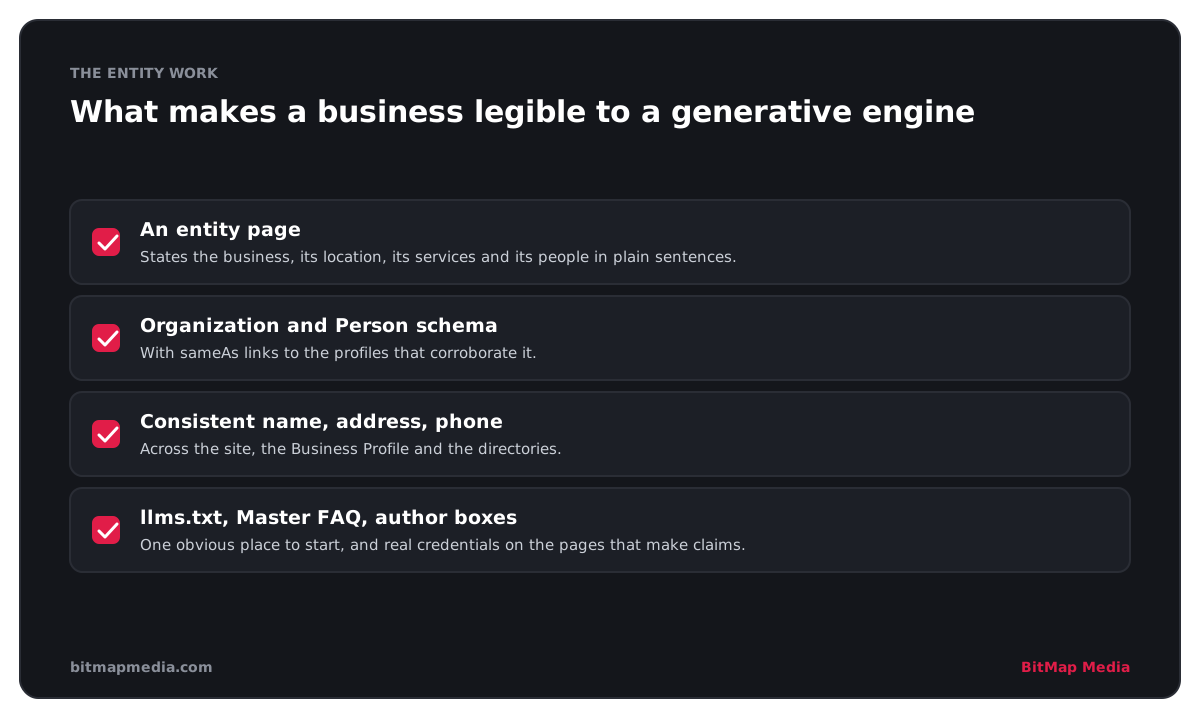
What are the generative engine optimization statistics?
The GEO study by Aggarwal et al. (KDD 2024) found that optimization methods can raise a source's visibility in generative engine answers by up to 40%. Keyword stuffing did little.
Statistics last updated 10-30-2026. Each figure links to the organization that first published it.
- Generative engine optimization methods can raise a source's visibility in generative engine answers by up to 40%, according to the GEO study by Aggarwal et al. (KDD 2024). Source: Aggarwal et al., 2024.
- GEO-bench, the benchmark built for the GEO study by Aggarwal et al., holds 10K queries split into 8K training, 1K validation and 1K test queries. Source: Aggarwal et al., 2024.
- In the GEO study by Aggarwal et al. (KDD 2024), citing sources, adding quotations and adding statistics each improved visibility by 30-40% on the Position-Adjusted Word Count measure and 15-30% on the Subjective Impression measure. Source: Aggarwal et al., 2024.
- The best methods in the GEO study by Aggarwal et al. beat the baseline by 41% on Position-Adjusted Word Count and 28% on Subjective Impression. Source: Aggarwal et al., 2024.
- Keyword stuffing gave little to no improvement in generative engine answers in the GEO study by Aggarwal et al. (KDD 2024). Source: Aggarwal et al., 2024.
Generative engine optimization questions
What is generative engine optimization (GEO)?
GEO is the work of making your facts quotable by generative engines such as ChatGPT, Gemini, Perplexity and Copilot. It covers how facts are written so they survive being lifted out of context, and how clearly your business is defined as an entity across your site and the wider web.
How is GEO different from AEO?
AEO is about the shape of the answer on the page: the question heading and the short answer beneath it. GEO is about the substance: whether a sentence quoted on its own is still true and still names you, and whether the engine can work out that your business is a specific thing in the world.
Can I pay to appear in an AI answer?
Not today. There is no advertising slot inside an AI Overview or a ChatGPT answer. Anyone offering to place you in one is selling something else. Citation comes from ranking, structure, clarity and mentions on the sources those engines already trust.
Does llms.txt make a difference?
It is an emerging convention, not a rule, and the engines are not obliged to read it. We publish one because it costs very little, it cannot hurt, and if adoption grows you are already there. We will not tell you it is doing more than that.
Why do you insist on naming the business instead of saying we?
Because a sentence gets quoted alone. A line reading we serve the tri-county area means nothing once it is separated from your page. BitMap Media serves businesses across the United States from Coral Springs, Florida still means something wherever it lands.
What is an entity page and why does it matter?
A page that states plainly what your business is, where it operates, who runs it and what it sells, backed by Organization and Person schema and sameAs links to the profiles that confirm it. It gives the engine one authoritative place to resolve who you are.
Do mentions matter more than links now?
They matter alongside links. Classic SEO authority came largely through links. Generative engines also weigh being mentioned and described on sources they already read, which is why directory accuracy, profiles and genuine coverage carry more weight than they used to.
How long before GEO work shows up in answers?
It varies with crawl frequency, competition and the authority the site already has. Google's own guidance is that crawling alone can take anywhere from a few days to a few weeks, and nothing you change counts until it has been crawled and indexed. We will not put a date on it. We report the movement monthly, so you are never waiting in the dark.
Who checks the AI-written content before it is published?
A senior marketer. There is a human in the loop on every page we publish: AI drafts it, a marketer verifies the facts against your own material and signs it against an eight-point content check. An answer engine lifting text from your page cannot tell a confident sentence from a correct one, so that check is doing the work. Separately, every client site gets a 300+ point audit at onboarding and a 300+ point scan in every monthly report.

Marketers with decades across print, TV, direct mail, email, web, video and CRM. Updated 10-30-2026. About the team