AI uplift for existing medical sites: trust signals and clear answers.
Medical SEO for the practice website you already have. Medical search is held to a higher bar by every engine. We uplift the site you already have with named clinicians, MedicalBusiness and Person schema and clinician-approved answers, without changing its design or web addresses.
Score your site free
Sources
- 1What do medical practice sites usually get wrong?
- 2What does our medical SEO work build for medical practices?
- 3What do patients search for before they choose a practice?
- 4How does a medical site get uplifted without a redesign?
- 5What do the statistics say about how patients find a medical practice?
- 6Questions from medical practices
Key takeaways: medical SEO
- Why is medical content treated differently? Search engines weigh accuracy, author credentials and trust signals far more heavily on health topics, because the cost of a wrong answer is higher.
- What does that require on the page? Named clinicians with real credentials, Person and MedicalBusiness schema, sourced claims, and a visible review date.
- What do patients search for? Symptoms, conditions, procedures, cost, insurance and whether you are accepting new patients, nearly all as questions.
- Who reviews the content? We draft it and your clinicians sign it off. Nothing clinical publishes on a practice site without a qualified human approving it.
- What is medical SEO on a pre-existing site? Healthcare SEO without a redesign: named clinicians, MedicalBusiness and Person schema, and answer-first pages that meet the higher bar health content is held to.
What do medical practice sites usually get wrong?
Five things: clinician pages with a photo and a first name but no verifiable credentials, condition pages copied from a content mill, no review date, insurance and cost information missing, and schema that claims a medical entity the page does not support. That is not a medical practice website design problem. It is medical SEO, and it can be fixed on the pages you have.
Medical SEO starts by fixing these five things. Each of the five is a medical SEO problem, and each can be fixed.
- Clinician pages with a photo and a first name, and no credentials an engine can verify
- Condition pages copied from a content mill that any practice in the country could have published
- No review date, so a visitor cannot tell whether the information is current
- Insurance and cost information missing, which is the most common reason a patient rings a competitor
- Schema that claims a medical entity the page does not actually support
What does our medical SEO work build for medical practices?
- Clinician pages with full credentials, affiliations and Person schema with sameAs links
- Condition and procedure pages answering the patient's question first, in language they use
- A visible reviewed-by line and date on clinical content, kept honest, never decorative
- MedicalBusiness and Service schema validated against the current vocabulary
- Insurance, cost and new-patient information stated plainly where people look for it
What do patients search for before they choose a practice?
Symptoms, conditions, procedures, cost, insurance and whether you are accepting new patients. Nearly all of it is typed as a question, and the practice whose page answers that question in its first paragraph is the one the engines quote.
Medical SEO puts those answers where a patient can find them. Healthcare SEO begins with that list. A page that answers them is the core of medical SEO.
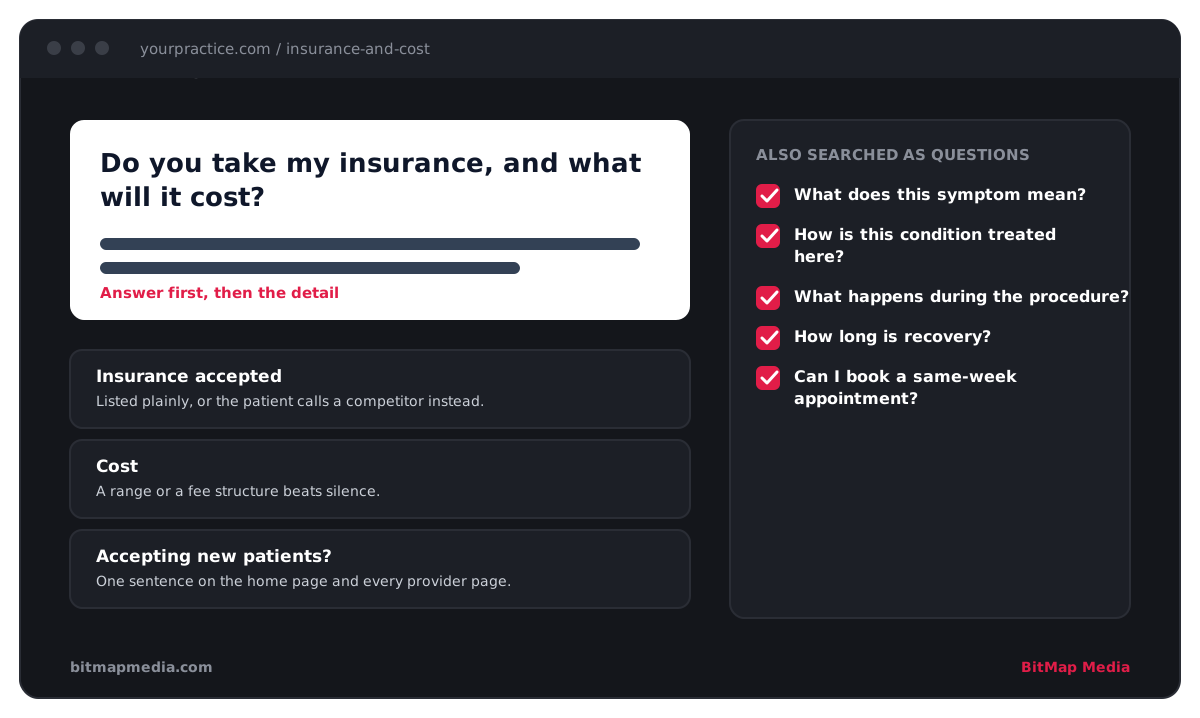
- "Do you take my insurance?" is the question that most often ends with a call to a competitor when the page does not answer it.
- Cost questions are rarely answered on practice sites, so a plain range or a fee structure stands out.
- "Are you accepting new patients?" deserves its own sentence on the home page and on every provider page.
- Condition and procedure questions want the answer first and the clinical detail second, in the words a patient would use.
How does a medical site get uplifted without a redesign?
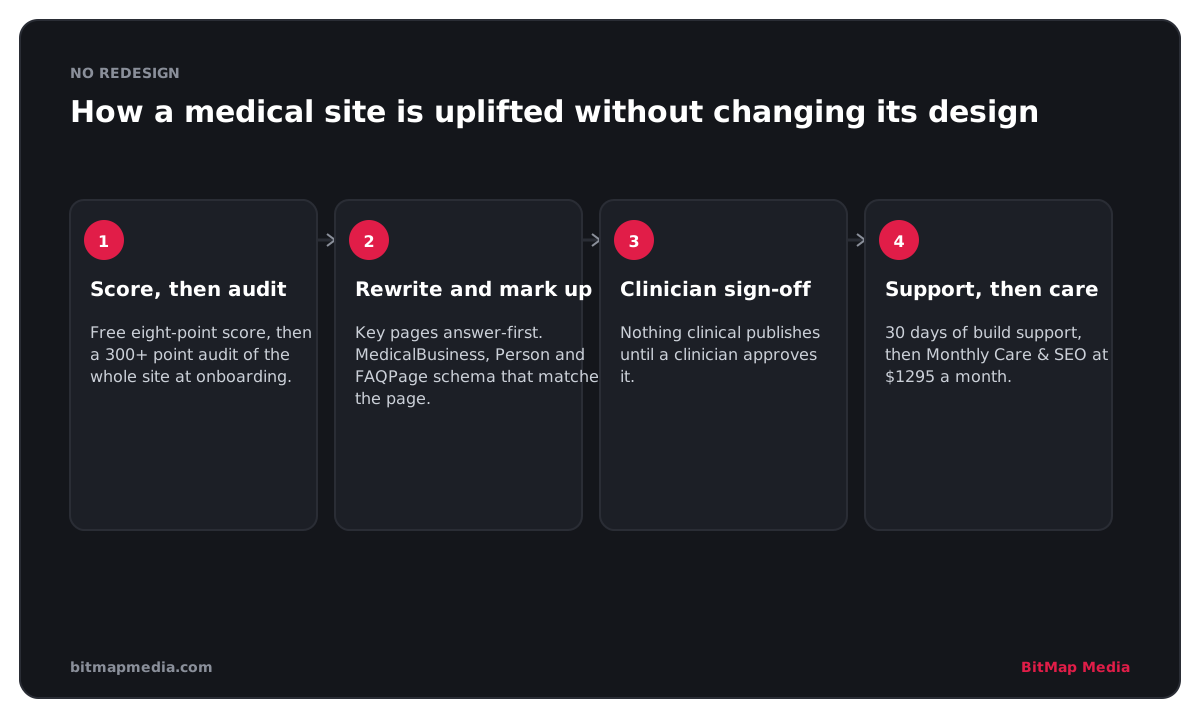
The design and the web addresses stay. We rewrite the key pages answer-first, add MedicalBusiness, Person and FAQPage schema that matches what is on the page, and route every clinical sentence through your clinicians before it goes live.
That is medical SEO without a redesign. Medical SEO of this kind keeps the site patients already know.
- It starts with the free eight-point AI Visibility Score, then a 300+ point audit of the whole site at onboarding.
- Provider pages get full credentials, affiliations and Person schema. Nothing clinical publishes without a clinician's sign-off.
- The AI Uplift is $1480 plus $165 a page, and the AI Citation Kit is included at no extra charge.
- Every uplift carries 30 days of build support, and Monthly Care & SEO at $1295 a month keeps the site audited and current after that.
What do the statistics say about how patients find a medical practice?
Most patients research health questions online before they choose a practice. The CDC found 58.5% of US adults looked for health information online, and KFF found 29% now use AI chatbots for it every month.
Statistics last updated 10-30-2026. Each figure links to the organization that first published it.
- 58.5% of US adults used the internet to look for health or medical information during July to December 2022, according to the CDC's National Center for Health Statistics. Source: CDC National Center for Health Statistics, 2023.
- 29% of US adults use AI tools or chatbots such as ChatGPT, Google Gemini or Claude for health information and advice at least monthly, up from 17% in June 2024, according to KFF's June 2026 poll. Source: KFF, 2026.
- 44% of US adults are not too or not at all confident they can tell whether health information from AI chatbots is true or false, according to KFF's June 2026 poll. Source: KFF, 2026.
- Six in ten US adults say they read AI search engine summaries, according to Pew Research Center's February 2026 survey. Source: Pew Research Center, 2026.
- US adults in Pew Research Center's March 2025 study clicked a traditional search result on 8% of visits with an AI summary, compared with 15% of visits without one. Source: Pew Research Center, 2025.
Questions from medical practices
Do you write the clinical content yourselves?
AI produces a first draft from your material and a senior marketer edits it, then your clinicians review and approve anything clinical before it goes live. The sign-off is not a formality; it is how the page earns its credibility.
What are the trust signals that actually matter?
Named authors with verifiable credentials, matching Person schema, a real reviewed date, sourced claims and an obvious contact route. Engines look for the same things a cautious patient does.
Is patient information ever used on the site?
No. Nothing patient-identifying goes on the site or into schema. Testimonials, if you use them, are handled with written consent and never include clinical detail.
Can you help with multi-provider or multi-site practices?
Yes. Each provider gets an entity, each location gets its own page, schema and Business Profile, and the internal linking keeps them from competing with each other.
How is this different from your dental work?
The structure is the same and the schema differs. Dentistry has its own type and a shorter decision cycle; general medical practices need more careful condition content and heavier author credentialing.

Marketers with decades across print, TV, direct mail, email, web, video and CRM. Updated 10-30-2026. About the team