How search works now, explained without the jargon.
This knowledge base is written for owners and their teams, not for other agencies. Every guide answers one question and says plainly when something is unproven.

Sources
- 1Start here in the knowledge base
- 2Structured data guides in the knowledge base
- 3Local search
- 4Knowledge base guides for owners
- 5How is each guide in the knowledge base written and checked?
- 6How does the knowledge base connect to the work we do?
- 7Want the short version for your own site?
- 8Knowledge base questions
Key takeaways: the knowledge base
- What is in the knowledge base? Plain-language guides to AI search, structured data, local SEO and website ownership, each answering one question.
- Who is it written for? Business owners and their teams, not other agencies. No jargon, and we say plainly when something is unproven.
- Where should I start? With the free eight-point AI Visibility Score. It tells you which of these guides you actually need. Once you become a client, we run the 300+ point deep-dive check across the whole site.
- Is any of it gated? No. Every guide is free to read, with no email wall and no download form.

Start here in the knowledge base
What AI-ready actually means
The eight points a page has to pass before ChatGPT, Gemini or Perplexity will quote it, and what each one checks.
SEO, AEO, GEO and AIO
Four acronyms, a lot of overlap and some genuine differences. What each one asks of a page, and which ones your business needs.
How the engines decide who to cite
What is actually known about how ChatGPT, Google AI Overviews, Perplexity and Copilot choose sources, and what is still guesswork.
The AI answer and the Bing and Google map pack
Why the top of a search result is now an answer and a map, and what that has done to the click you used to get.
Structured data guides in the knowledge base
Schema for service businesses
LocalBusiness, Service, FAQPage and Person, what each one is for, and the mistakes that make Google ignore all of them.
llms.txt explained
What the file is, what it claims to do, what is actually proven, and why we still publish one.
The Master FAQ
One page that answers every question a buyer and an engine might ask, and how it feeds the rest of the site.
Entity pages and why you need them
How a search engine works out that your business is a thing in the world, and the pages that tell it.
Local search
Google Business Profile, done properly
Categories, services, hours, photos and the fields most owners never fill in, which is where the Bing and Google map pack is won.
Getting into the Bing and Google map pack
Proximity, prominence and relevance in plain language, and which of the three you can actually influence.
NAP consistency
Why your name, address and phone number being slightly different in six places quietly costs you rankings.
Reviews without gaming them
How to ask, when to ask, how to answer the bad ones, and what not to do.
Knowledge base guides for owners
What a website care plan should include
Updates, backups, security, uptime and the on-page work. What is standard, what is padding, and what is missing from most plans.
How to read your Search Console
Four numbers, what each one means, and the three reports worth opening every month.
Questions to ask before you hire an agency
Fifteen questions with the answers you want to hear, including the ones that would cost us business.
Who owns your website?
Domain, hosting, admin, theme, content and data. How to check today, and what to fix if the answer is not you.
How is each guide in the knowledge base written and checked?
AI writes the first draft from our own material. A senior marketer then checks every fact, cuts the filler and signs the page against the same eight-point content check we use on client sites. If something is unproven, the guide says so.
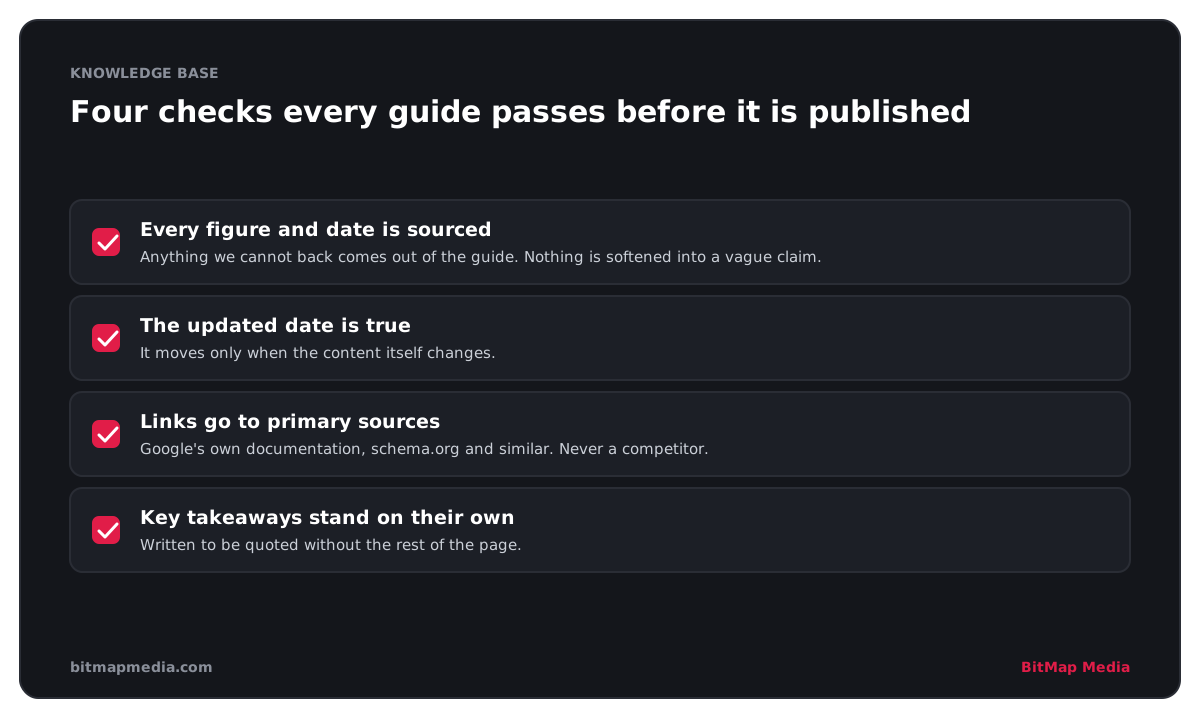
Every guide in the knowledge base goes through the same check.
- Every figure and date in a guide is sourced, or it comes out. We do not soften a claim we cannot back.
- Each guide has an updated date that moves only when the content changes.
- Links go to primary sources such as Google's own documentation and the schema.org vocabulary, never to a competitor.
- The Key takeaways block at the top of each guide is written to be quoted on its own, so a reader who scrolls no further still leaves with the point.
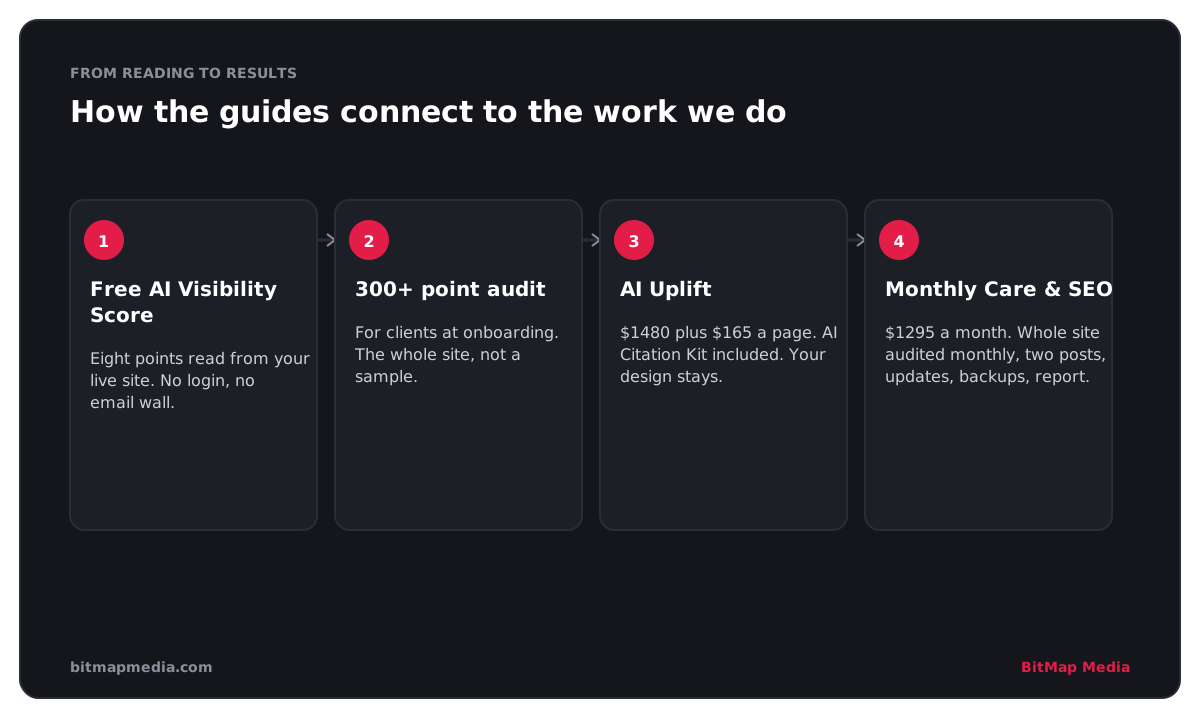
How does the knowledge base connect to the work we do?
The guides explain what we fix. The free AI Visibility Score shows which of those fixes your own site needs. From there, the AI Uplift does the work on the pages you already have, and Monthly Care & SEO keeps it current.
The knowledge base is free to read.
- Step one is the free score: eight points, read from your live site, no login and no email wall.
- Step two, for clients, is the 300+ point audit at onboarding, which covers the whole site rather than a sample.
- Step three is the AI Uplift at $1480 plus $165 a page, with the AI Citation Kit included at no extra charge.
- Step four is Monthly Care & SEO at $1295 a month: the whole site audited every month, two new posts, updates, backups and a plain-language report.
Want the short version for your own site?
The free AI Visibility Score runs the eight-point check against your website and tells you which of these guides you actually need to read. It does not ask for a login.
The score is the quickest way into the knowledge base for your own site.
Get your Free AI Visibility ScoreKnowledge base questions
How often are the guides updated?
When the facts change. Each guide carries an updated date that moves only when the content itself has been revised, so a date you see is a date you can trust.
Can I ask for a guide on a topic that is not here?
Yes. Email GrowWith@BitMapMedia.com with the question. If enough people ask it, it becomes a guide, written and checked the same way as the sixteen already here.
Do the guides tell me how to do the work myself?
They explain what the work is and why it matters. The doing is our service: the free AI Visibility Score shows what your site needs, and the AI Uplift fixes it on the pages you already have.
Are the guides written by AI?
AI writes the first draft from our own material. A senior marketer then checks every fact, cuts the filler and signs the page. Nothing publishes on an unverified claim.

Marketers with decades across print, TV, direct mail, email, web, video and CRM. Updated 10-30-2026. About the team
Related pages
Reference: the schema.org vocabulary.