Answer engine optimization: be the answer that the engine quotes.
Question headings, answer-first blocks, matching schema and clean entities, on pages that already rank. Included in every build and upgrade, never a separate invoice.
Check your pages free
Sources
- 1What is answer engine optimization?
- 2What answer engine work changes on the page
- 3How does AEO differ from traditional SEO?
- 4In what order do we do answer engine optimization?
- 5Who answer engine optimization helps the most
- 6What are the latest answer engine statistics?
- 7Answer engine optimization questions
Key takeaways: answer engine optimization
- What is answer engine optimization? Structuring a page so an answer engine can lift a correct, complete answer straight out of it: a question heading, a twenty to forty word answer directly underneath, and schema that matches.
- How is AEO different from SEO? SEO decides whether the page is found. AEO decides whether the answer on it can be quoted. The same page needs both, and the ranking has to come first.
- Which engines does it affect? Google AI Overviews and featured snippets, ChatGPT, Perplexity, Copilot, Gemini, and voice assistants reading a single answer aloud.
- What does it cost? It is part of the 300+ point audit, so it comes with every build and upgrade and is never sold separately. An uplift is $1480 plus $165 a page, a new build is quoted from $1980 plus $245 a page, and the AI Visibility Score is free.
What is answer engine optimization?
Answer engine optimization is the practice of structuring a page so that a machine can read it and produce a complete, correct answer without a person clicking through. It is the difference between a page that contains the answer somewhere and a page that hands the answer over.
Traditional SEO asks whether your page can be found. AEO asks a narrower question: when the engine has found it, can it quote you accurately in two sentences? Most business websites fail that second test while passing the first, because they were written to be browsed, with no thought to being extracted from.
What answer engine work changes on the page
Question headings
Headings written as the question a customer actually types, not as a marketing phrase. "How much does a website cost?" works. "Investment" does not.
Answer-first paragraphs
Twenty to forty words directly under the heading that answer it completely. Background, nuance and proof come after, never before.
Named entities
The business name, the service and the place stated in full, with no "we", "it" or "the area". A quoted sentence has to survive on its own.
Matching schema
FAQPage, Service and LocalBusiness markup that reflects what is visibly on the page, validated against the current schema.org vocabulary.
Full 5W1H coverage
Who, what, where, when, why and how answered somewhere on the page, because that is the shape of the questions people ask out loud.
Server-rendered HTML
The substance in the page source, not injected by JavaScript and not hidden inside a collapsed widget an engine may never open.
How does AEO differ from traditional SEO?
They share a foundation and diverge in format. SEO decides whether you are in the running. AEO decides whether the engine can use you once you are.
Put simply, answer engine work begins where ranking work ends.
| Traditional SEO | Answer engine optimization | |
|---|---|---|
| The goal | Rank the page | Get the answer on it quoted |
| Written for | A reader who will scroll | A machine that will extract, and a reader who will skim |
| Headings | Keyword phrases | The questions customers type |
| First paragraph | Sets up the topic | Answers the heading outright |
| Success looks like | Position and clicks | Being named in the answer, with or without a click |
| Still needs the other? | Yes | Yes, and it needs SEO first |
In what order do we do answer engine optimization?
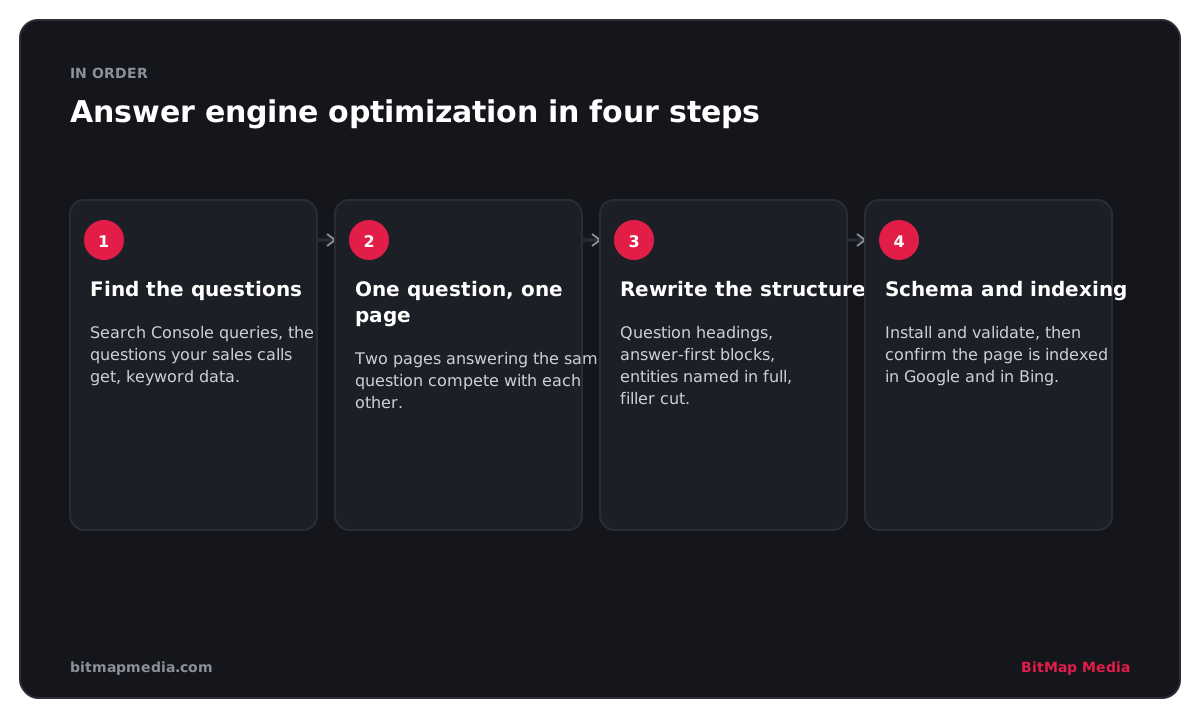
- Step 01Find the questions. Search Console queries, the questions your sales calls actually get, and keyword data for volume and difficulty.
- Step 02Map one question to one page. Two pages answering the same question compete with each other and neither wins.
- Step 03Rewrite the structure. Question headings, answer-first blocks, entities named in full, filler cut.
- Step 04Install and validate the schema, then confirm the page is indexed in Google and in Bing.
Who answer engine optimization helps the most
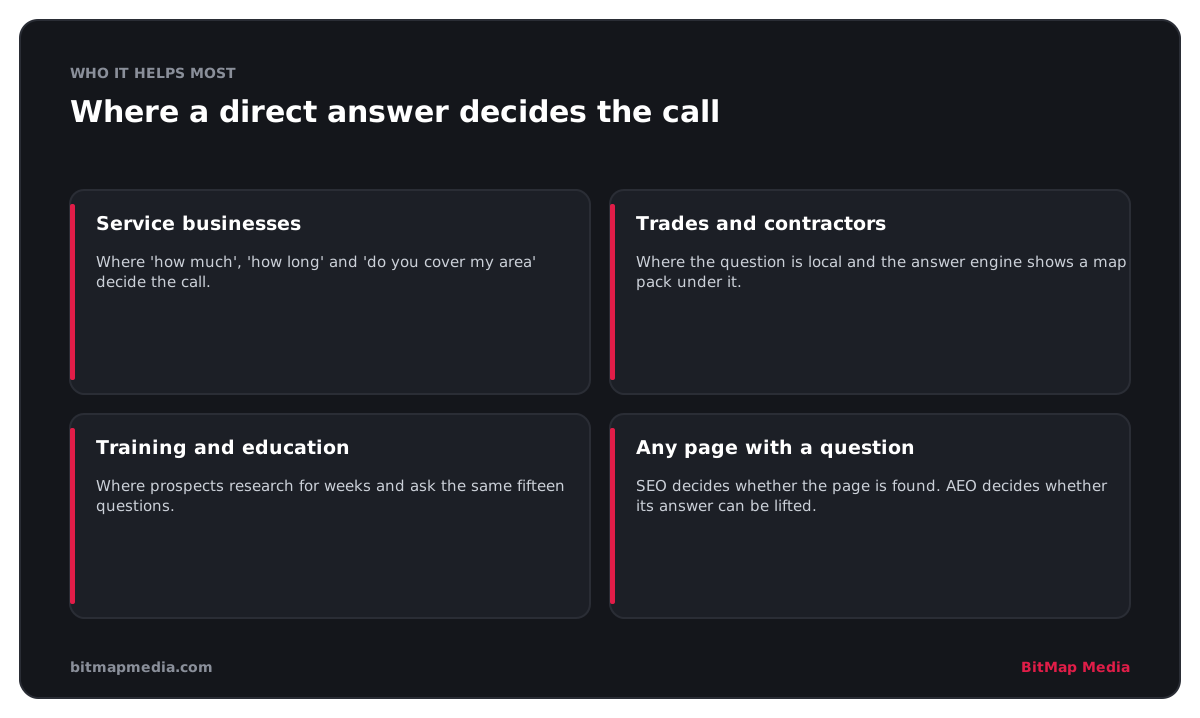
Businesses whose customers ask questions before they buy. If somebody types a question, asks a voice assistant, or puts it to ChatGPT before picking up the phone, the answer they get is your first impression whether or not they ever reach your site.
Those are the businesses answer engine work is built for.
- Service businesses
Where "how much", "how long" and "do you cover my area" decide the call. - Trades and contractors
Where the question is local and the answer engine shows a Bing and Google map pack underneath its answer. - Training and education
Where prospective customers research for weeks and ask the same fifteen questions in a different order every time.
What are the latest answer engine statistics?
Six in ten US adults say they read AI search summaries, Pew Research Center found in 2026. Only 6% of adults who see them trust the information a lot.
Statistics last updated 10-30-2026. Each figure links to the organization that first published it.
- Six in ten US adults say they read AI search engine summaries, according to Pew Research Center's February 2026 survey. Source: Pew Research Center, 2026.
- 53% of US adults who have come across AI summaries in search results have at least some trust in the information, according to Pew Research Center's August 2025 survey. Source: Pew Research Center, 2025.
- Only 6% of US adults who have come across AI summaries in search results trust the information a lot, according to Pew Research Center's August 2025 survey. Source: Pew Research Center, 2025.
- One in five US adults find AI summaries in search results extremely or very useful, according to Pew Research Center's August 2025 survey. Source: Pew Research Center, 2025.
- Google AI Mode has passed 1 billion monthly active users, Alphabet CEO Sundar Pichai said in the company's Q2 2026 earnings remarks. Source: Alphabet, 2026.
Answer engine optimization questions
What is answer engine optimization (AEO)?
AEO is the work of structuring a page, so an answer engine can extract a complete, correct answer from it without a human clicking through. In practice that means a question-form heading, an answer of roughly twenty to forty words immediately beneath it, named entities instead of pronouns, and FAQ or Service schema that matches what the page visibly says.
Is AEO just a new name for featured snippets?
It grew out of that work and goes further. Optimizing for a featured snippet aimed at one box on one Google results page. AEO aims at every surface that reads a page and speaks a single answer: AI Overviews, ChatGPT, Perplexity, Copilot and voice assistants, each of which picks its source differently.
Do I need to rank before AEO helps?
Google's published requirement is that the page is crawled, indexed and eligible to be shown in Search with a snippet, not that it holds a particular position. The traditional foundation is still not optional: we work the ranking first, then the answer structure on top of it.
What does an answer-first block actually look like?
A heading written as the question a customer types, then a short paragraph that answers it completely before any setup or background. If the reader stops after that paragraph they still have the answer, and so does the engine.
Will answer-first writing hurt my page for human readers?
The opposite, in our experience. Readers skim for the answer too. Putting it first and elaborating afterward is how reference writing has always worked; it only feels unusual if you are used to marketing copy that builds to a point.
How do you know whether it is working?
Search Console shows the clicks, impressions and average position for the searches that bring up your pages.
Can you guarantee my answer gets picked?
No, and nobody honestly can. The engines choose, they change how they choose, and they personalize by location and device. What we control is whether your page is eligible: ranked, structured, schema-valid and indexed in both Google and Bing.
Is AEO a separate service with a separate invoice?
No. It is part of every build and every upgrade, and it is in the Monthly Care & SEO plan. There is no separate AEO line item, because a page either answers well or it does not.
Who checks the AI-written content before it is published?
A senior marketer. There is a human in the loop on every page we publish: AI drafts it, a marketer verifies the facts against your own material and signs it against an eight-point content check. An answer engine lifting text from your page cannot tell a confident sentence from a correct one, so that check is doing the work. Separately, every client site gets a 300+ point audit at onboarding and a 300+ point scan in every monthly report.

Marketers with decades across print, TV, direct mail, email, web, video and CRM. Updated 10-30-2026. About the team
See which of your pages an engine can actually quote.
The free AI Visibility Score runs the eight-point check on your site and shows which pages have an answer an engine can lift, and which do not.
Get your Free AI Visibility Score