AI uplift for pre-existing dental sites: answer what patients ask.
Dental SEO for the site you already have. Your practice site already exists. We make it answer the questions patients type, about cost, pain, sedation and insurance, so Google ranks it, the Bing and Google map pack lists you and AI answers quote it. Same design, same web addresses.
Score your site free
Sources
Key takeaways: dental SEO
- What do dental patients search for? Procedures, cost, pain, sedation, insurance and whether you take new patients. Almost all of it phrased as a question.
- Why does that suit AI search? Because a question with a clear answer is exactly what an answer engine lifts. Dentistry is one of the best-fit verticals for this work.
- What schema do dental sites need? Dentist and MedicalBusiness for the practice, Service for each procedure, FAQPage for the questions, and Person for the clinicians.
- What does it cost? The same published prices as every other vertical: an uplift is $1480 plus $165 a page, a new build is quoted from $1980 plus $245 a page, and Monthly Care & SEO is $1295 a month.
- What is dental SEO on a pre-existing site? Dental website SEO without a redesign: Dentist schema, procedure pages that answer the patient's question first, and indexing that gets them seen.
What does a typical dental site get wrong?
Five things: procedure pages that describe the technique instead of cost and pain, one generic services page covering twelve procedures, clinician photos with no names or credentials, insurance and payment information buried or missing, and no answer to the first question new patients ask: are you taking new patients. None of that is dental website design. It is dental SEO, and it can be fixed on the pages you have.
Dental SEO starts by fixing these five things.
- Procedure pages that describe the technique instead of answering what it costs and whether it hurts
- One generic services page covering twelve procedures, so none of them can rank for anything
- Clinician photos with no names, no credentials and no Person schema behind them
- Insurance and payment information buried on a contact page or missing entirely
- No answer anywhere to the question almost every new patient asks first: are you taking new patients
What does our dental SEO work build for dental practices?
A page per procedure headed by the question a patient types, with cost, duration, recovery and sedation options stated plainly. Validated Dentist, MedicalBusiness, Service and FAQPage schema, named clinicians with real credentials and Person schema, a properly completed Google Business Profile, and published prices.
That is what dental SEO looks like on the page. Dental SEO done this way answers the patient before the first call.
- A page per procedure, each headed by the question a patient types and answered in the first paragraph
- Cost, duration, recovery and sedation options stated plainly on the page, so nobody has to phone to ask
- Dentist, MedicalBusiness, Service and FAQPage schema, validated, never assumed
- Named clinicians with real credentials and Person schema, because health content is held to a higher trust bar
- Google Business Profile completed properly, because dental search is local search first
What does an uplifted dental procedure page look like?
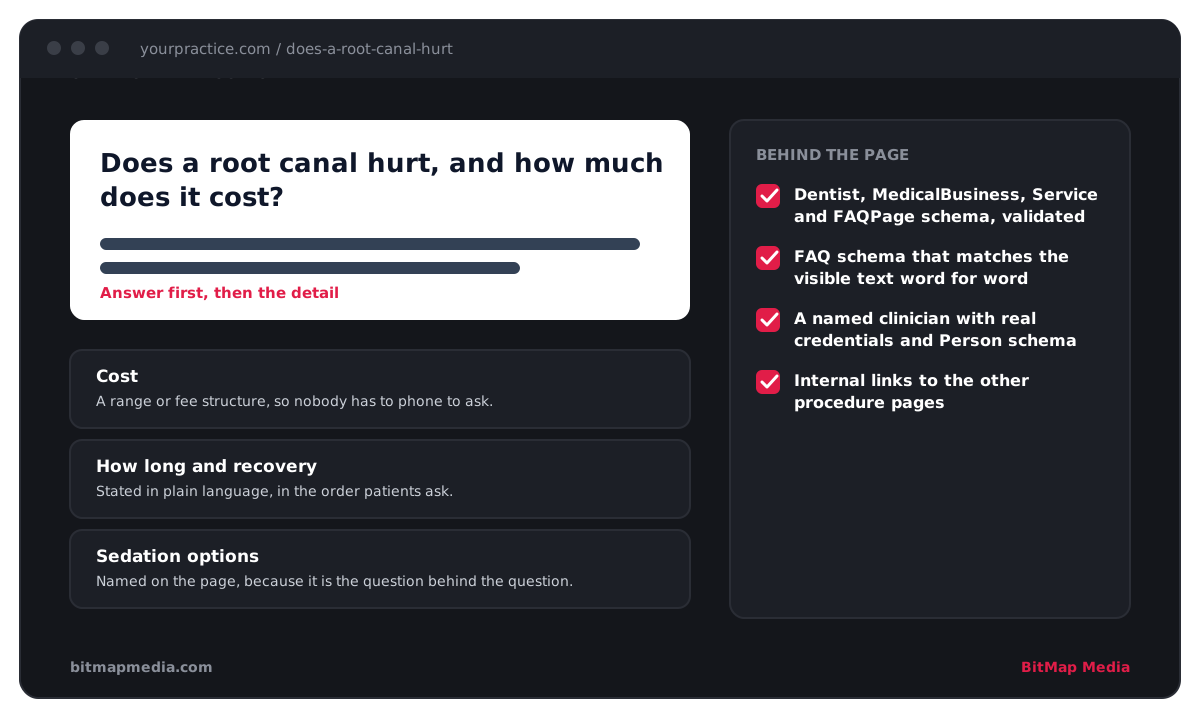
One page per procedure, headed by the question a patient types. The first paragraph answers it. Cost, how long it takes, recovery and sedation options follow in plain language, then an FAQ whose schema matches the visible text word for word.
A procedure page like this is the center of dental SEO. Dental website SEO of this kind keeps the design and changes the words.
- Heading: "Does a root canal hurt?" or "How much does a crown cost?". "Endodontics" is a category, and nobody types it.
- Cost stated as a range or a fee structure, so nobody has to phone to find out.
- Dentist, MedicalBusiness, Service and FAQPage schema, validated against the current schema.org vocabulary before it ships.
- A named clinician with real credentials and Person schema attached to the page, because health content is held to a higher trust bar.
How does local search fit into dental SEO?
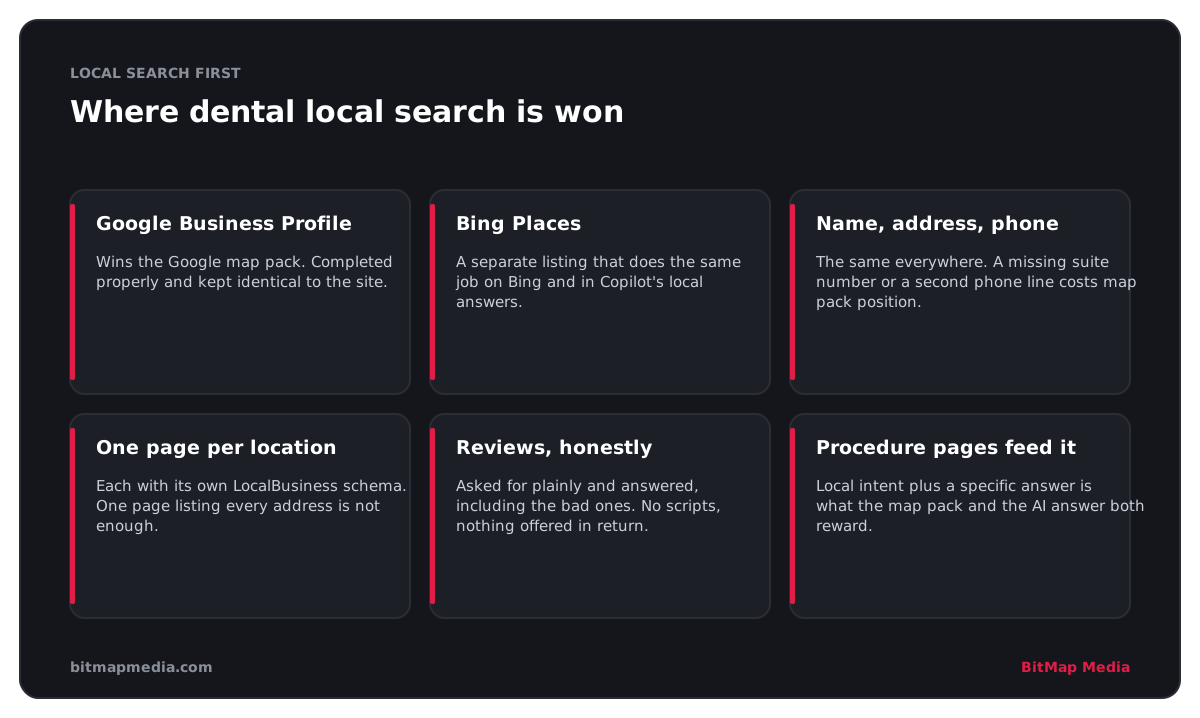
Dental search is local search first. We complete the Google Business Profile and the Bing Places listing to match the site exactly, give each location its own page and schema, and ask for reviews honestly.
Local listings are the first half of dental SEO, and the website is the second. We treat the profile and the site as one dental SEO job.
- Google Business Profile wins the Google map pack; Bing Places does the same on Bing, and both are kept identical to the site.
- Name, address and phone are made the same everywhere, because a missing suite number or a second phone line quietly costs map pack position.
- Multi-location practices get a page per location with its own LocalBusiness schema. A single page listing every address is not enough.
- Reviews are asked for plainly and answered, including the bad ones. We do not script the wording or offer anything for a review.
What do the statistics say about how patients find a dentist?
Dental patients look up health information online and read reviews before they call. KFF found 29% of US adults use AI chatbots for health information every month, and 88% of dentists surveyed by the ADA had been reviewed online.
Statistics last updated 10-30-2026. Each figure links to the organization that first published it.
- 29% of US adults use AI tools or chatbots such as ChatGPT, Google Gemini or Claude for health information and advice at least monthly, up from 17% in June 2024, according to KFF's June 2026 poll. Source: KFF, 2026.
- 88% of dentists surveyed by the ADA Health Policy Institute reported receiving patient reviews online. Source: American Dental Association, 2023.
- 39% of dentists in the same ADA Health Policy Institute survey said they were unable to respond to online reviews because of HIPAA regulations. Source: American Dental Association, 2023.
- 20% of US adults say they use AI chatbots to get medical advice, according to Pew Research Center's February 2026 survey. Source: Pew Research Center, 2026.
- Google drove more than 2.5 billion direct connections a month to American businesses in 2025, including phone calls, direction requests, messages, bookings and reviews. Source: Google, 2026.
Questions from dental practices
Is health content held to a higher standard by search engines?
Yes. Search engines treat medical and dental content as higher-risk and weigh author credentials, accuracy and trust signals more heavily. That is why named clinicians, real credentials and matching Person schema matter more here than in most verticals.
Can you write clinical content for us?
AI drafts it, and a senior marketer edits it against your own material. Anything clinical is written to be reviewed and signed off by your clinicians before it publishes. We do not put unreviewed medical claims on a practice site.
What about patient privacy?
Nothing patient-identifying goes on the site or into schema, and our Quiet Client promise means we never publish your practice name as a client either.
Do you work with dental training and education as well as practices?
Yes. Course pages, program schema and the question-led structure work the same way, and the buying cycle is longer so the FAQ work pays off more.
How do you handle multiple locations?
A page per location with its own LocalBusiness schema and its own Business Profile. One page listing every address is not enough, because each location needs to be its own findable entity.

Marketers with decades across print, TV, direct mail, email, web, video and CRM. Updated 10-30-2026. About the team