AI uplift for existing law firm sites: answer before the consultation.
Law firm SEO for the website you already have. People research a legal problem long before they call a lawyer. We uplift the site you already have so its practice-area pages answer those questions, written to your state’s advertising rules, without changing its design or web addresses.
Score your site free
Sources
Key takeaways: law firm SEO
- What do people search before hiring a lawyer? What their situation means, what it will cost, how long it takes, and whether they even have a case. Almost always as a question.
- Why does that favor AI search? Because the answer engines are answering exactly those questions, and most firm sites answer none of them in public.
- What schema applies? LegalService or Attorney for the firm, Service for each practice area, Person for each attorney, FAQPage for the questions.
- What about advertising rules? Bar advertising rules vary by state and apply to your website. We write to them and you or your compliance reviewer approves before anything publishes.
- What is law firm SEO on a pre-existing site? Legal SEO without a redesign: practice-area pages that answer the client's question first, LegalService and Attorney schema, and indexing.
What do law firm sites usually get wrong?
Five things: practice area pages that describe the law instead of the client's problem, attorney bios with nothing about what they do for a client, no cost information at all, a single contact form as the only call to action, and leftover result claims the state bar rules would not permit. None of that is law firm website design. It is law firm SEO, and it can be fixed on the pages you have.
Law firm SEO starts by fixing these five things. Each of the five is a legal SEO problem, and each can be fixed. None of the five is unusual, and law firm SEO addresses each one.
- Practice area pages that describe the area of law and say nothing about the problem the client has
- Attorney bios listing schools and admissions with nothing about what they actually do for a client
- No cost information at all, when cost is the second thing every prospective client wants to know
- A single contact form as the only call to action, with no way to self-assess first
- Claims about results that the state bar rules would not permit, left over from an old site
What does our law firm SEO work build for law firms?
A page per practice area headed by the client's problem, fee structures explained in plain terms, attorney pages with real credentials, Person schema and sameAs links to bar profiles, validated LegalService and Service schema with no result claims the rules would not allow, the questions your intake calls get published as answers, and published prices.
That is what law firm SEO looks like on the page. Legal SEO of this kind starts from the client and works back to the law.
- A page per practice area headed by the client's problem, not the legal category
- Fee structures explained: hourly, flat, contingency, what a consultation costs and what it covers
- Attorney pages with real credentials, Person schema and sameAs links to bar profiles
- LegalService and Service schema validated, with no result claims the rules would not allow
- The questions your intake calls actually get, published as answers with the caveats intact
What do prospective clients want to know before they call?
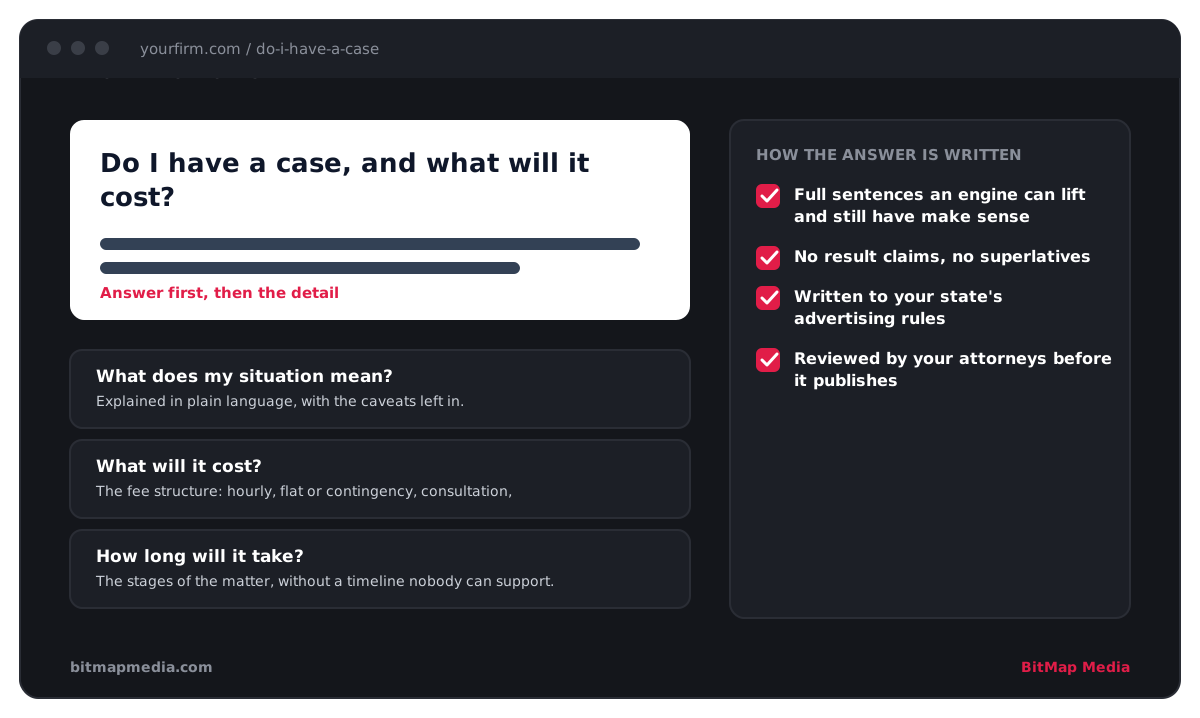
What their situation means, whether they have a case, what it will cost and how long it will take. Those four questions are typed into search long before anyone picks up a phone, and a practice-area page that answers them is the one that gets quoted.
Law firm SEO works when those four questions are answered on the page. Good legal SEO answers them before the first call.
- "Do I have a case?" wants an honest explanation of the factors, with the caveats left in. Promising an outcome is what the bar rules forbid.
- Cost questions are answered with the fee structure: hourly, flat or contingency, what a consultation costs and what a retainer covers.
- "How long does this take?" is answered with the stages of the matter, because a range you cannot support is a claim the bar rules would not permit.
- Each answer is written as full sentences an engine can lift out of the page and still have make sense.
How does the uplift stay inside bar advertising rules?
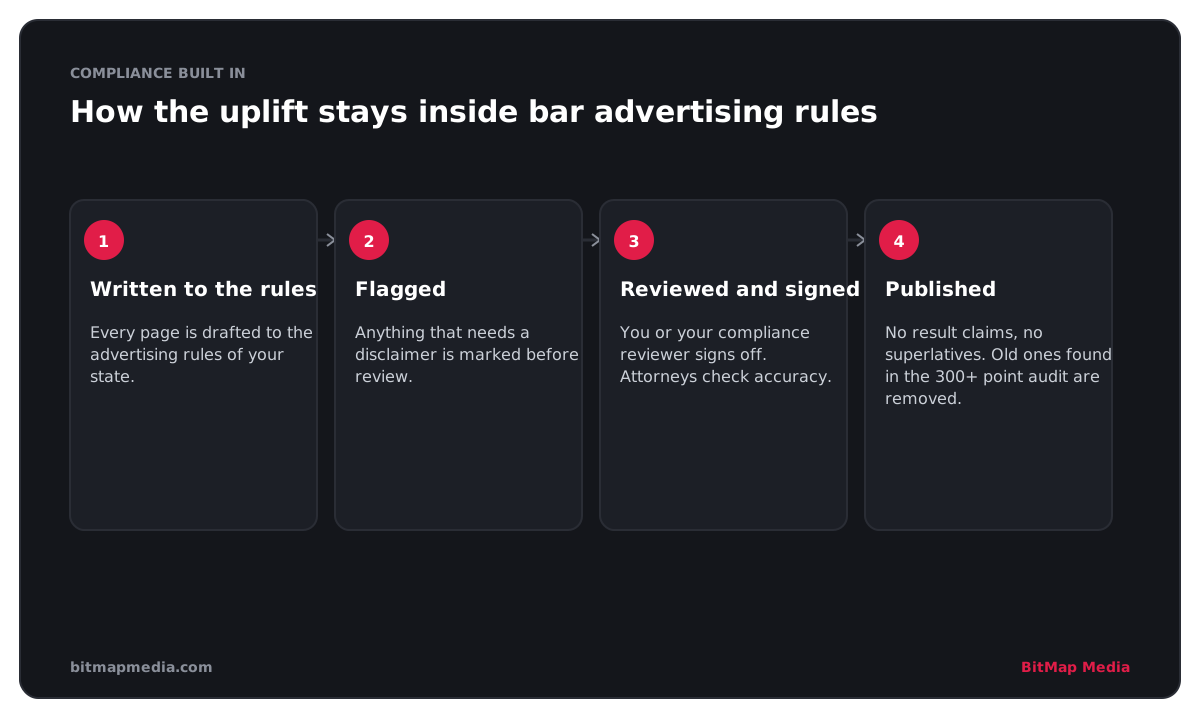
Every page is written to the advertising rules of your state, anything that needs a disclaimer is flagged, and nothing publishes until you or your compliance reviewer has signed it. No result claims and no superlatives go on a law firm site without that review.
Law firm SEO has to respect those rules, and ours does. Flagging is part of law firm SEO here. It is not an extra.
- AI drafts the page, a senior marketer edits it against your own material, and your attorneys review it for accuracy and compliance before it goes live.
- Leftover result claims from an old site are flagged in the 300+ point onboarding audit and removed before anything else publishes.
- Attorney pages carry real credentials, Person schema and sameAs links to bar profiles, so the facts an engine reads match the ones the bar holds.
- The uplift keeps your design and web addresses, costs $1480 plus $165 a page, and carries 30 days of build support.
What do the statistics say about how people find a lawyer?
Many people do not know how to find a lawyer they can afford. The Legal Services Corporation found 53% of low-income Americans are unsure they could, and Pew Research Center found 42% of US adults use AI chatbots to search for information.
Statistics last updated 10-30-2026. Each figure links to the organization that first published it.
- 53% of low-income Americans do not know if they could find and afford a lawyer if they needed one, according to the Legal Services Corporation's 2022 Justice Gap report. Source: Legal Services Corporation, 2022.
- Low-income Americans seek legal help for only 25% of the civil legal problems that substantially affect them, according to the Legal Services Corporation's 2022 Justice Gap report. Source: Legal Services Corporation, 2022.
- 46% of low-income Americans who did not seek legal help for one or more problems cited cost as a reason, according to the Legal Services Corporation's 2022 Justice Gap report. Source: Legal Services Corporation, 2022.
- 42% of US adults say they use AI chatbots to search for information, according to Pew Research Center's February 2026 survey. Source: Pew Research Center, 2026.
- Six in ten US adults say they read AI search engine summaries, according to Pew Research Center's February 2026 survey. Source: Pew Research Center, 2026.
Questions from law firms
Can we publish fees if our matters vary?
You can publish the structure, which is what people are actually asking about: hourly versus flat versus contingency, what a consultation costs, what a retainer covers. That is useful and compliant without committing you to a number.
How do you handle bar advertising rules?
We write to the rules in your state and flag anything that needs a disclaimer, then you or your compliance reviewer signs off before publication. We do not publish result claims or superlatives on a law firm site without that review.
Do you write legal content?
AI drafts it, a senior marketer edits it, and your attorneys review it for accuracy and compliance. Legal content that has not been reviewed by a lawyer does not go on a law firm site.
Will answering questions publicly cost us consultations?
It changes who calls more than how many. Someone who has read the answer and still calls is closer to hiring you than someone who called to ask what a term means.
What about client confidentiality?
Nothing identifying goes on the site. Case studies, where you want them, are anonymized to a matter type and an outcome, and Quiet Client means we never publish your firm as our client either.

Marketers with decades across print, TV, direct mail, email, web, video and CRM. Updated 10-30-2026. About the team
Related pages
Industries we build for
Reference: Google’s guidance on local ranking.