The AI answer and the map pack: what happened to your click.
Map pack answers and AI answers now sit above the result you worked for. One answers the question. The other lists three businesses. Understanding what each one took from you decides where the work goes.

Sources
Key takeaways
- What changed at the top of the page? An AI-generated answer often sits above everything, and for local searches a three-listing Bing and Google map pack sits under it. The first ordinary blue link can now be most of a screen down.
- Does an AI answer always cost me the click? No. It takes the clicks that were only ever looking for a fact, like opening hours. Searches where someone has to choose, book or buy still produce clicks, and those were always the valuable ones.
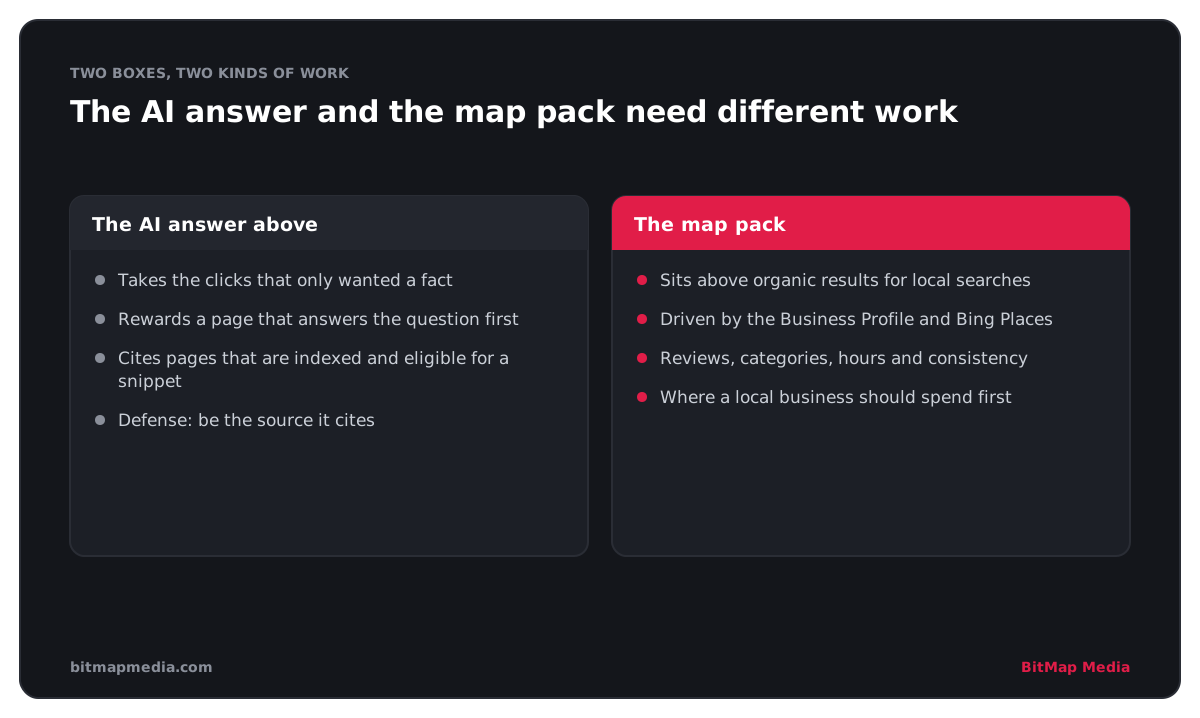
- What does the Bing and Google map pack need? Different work from the AI answer. The map packs are driven by your listings, proximity and reviews: Google Business Profile on Google, Bing Places on Bing. Your page copy does not drive it. See getting into the Bing and Google map pack.
- Where should a local business spend first? The Bing and Google map pack, because it sits above organic results for local intent and is the cheapest to influence. The AI answer layer comes second, on the pages that answer real buying questions.

Where Bing and Google map pack answers now sit above your result
On a question with a factual answer, Google often puts an AI-generated summary at the top, with links to the pages it drew from. On a search with local intent, a map and three business listings sit in the same region of the page. Either one can push the first ordinary result well down the screen.
Both have ancestors. Featured snippets have been taking informational clicks for a decade and the local pack has been there since 2015. What changed is how much vertical space the top of the page now occupies, and how often a searcher gets what they came for without scrolling.
Which clicks did you actually lose?
Not all of them, and not the ones that mattered most. It helps to split your queries into three groups.
| Query type | Example | What happens now |
|---|---|---|
| Fact lookup | “what temperature to set a water heater” | Answered in the box. This click is mostly gone, and it rarely became a customer. |
| Comparison or decision | “tankless vs tank water heater for a family of four” | Summarized, then clicked. People verify before spending. Being the cited source is the whole game. |
| Local and urgent | “water heater replacement near me” | Goes to the Bing and Google map pack. Your page copy barely matters here; your Business Profile decides it. |
Most owners we talk to are watching a single traffic number and assuming the worst. Split it three ways first. The picture is usually less alarming and far more actionable.
Why the two boxes need different work
An AI answer is built from pages. A Bing and Google map pack is built from a business listing. They draw on different inputs, and work on one does very little for the other.
To be in the AI answer, a page has to rank, be indexed in the right engine, and carry an answer an engine can lift whole. That is page work: headings, the first paragraph under them, named entities, matching schema.
To be in the Bing and Google map pack, your Google Business Profile has to be complete and categorized correctly, your name, address and phone number have to agree everywhere they appear, and your reviews have to be real and recent. That is profile work, and your website copy is a minor input to it.
Sites get sold “AI optimization” and then wonder why the phone did not ring in a business where every customer searches with the words “near me”. The answer is usually that the money went to the wrong box.
Where a local business should spend first
The Bing and Google map pack, then the answer layer. The profile work is cheaper, faster and sits above organic results for the searches that bring urgent customers. Once that is right, the page work on your three or four real buying questions is what gets you named when someone asks an assistant who to call.
We price both in the open. The One-Time Projects page lists each job, and every one of them is included in a build or an uplift at no extra charge.
What do the statistics say about AI answers and clicks?
Pew Research Center found US searchers clicked a traditional result on 8% of visits when an AI summary appeared, against 15% when none did. They also ended the session more often.
Statistics last updated 10-30-2026. Each figure links to the organization that first published it.
- In a Pew Research Center study of US adults' Google searches in March 2025, 18% of searches produced an AI summary. Source: Pew Research Center, 2025.
- US adults in Pew Research Center's March 2025 study clicked a traditional search result on 8% of visits with an AI summary, compared with 15% of visits without one. Source: Pew Research Center, 2025.
- Pew Research Center's March 2025 study found US adults clicked a link inside the AI summary on just 1% of visits to pages that showed one. Source: Pew Research Center, 2025.
- US adults in Pew Research Center's March 2025 study ended their browsing session on 26% of pages with an AI summary, compared with 16% of pages with only traditional results. Source: Pew Research Center, 2025.
- 65% of US adults at least sometimes come across AI summaries in search results, according to Pew Research Center's August 2025 survey. Source: Pew Research Center, 2025.
Questions about the new results page
Is my traffic going to drop?
On informational queries, very possibly, and that pattern started before AI answers with featured snippets. What to watch is not total clicks but clicks on the queries that produce inquiries. A site can lose a fifth of its traffic and gain inquiries if what it lost was people checking a fact.
How do I tell which of my queries are at risk?
We sort your Search Console queries by impressions and read them as questions. Anything a single sentence fully answers is exposed. Anything requiring a choice, a price, a booking or a look at your work is not.
If the AI answer quotes me, do I get anything?
A citation link, and in our experience a smaller number of better-qualified visitors. Someone who clicks through after reading a summary has already self-selected. Being the cited source also beats the alternative, which is your competitor being summarized instead of you.
Does the Bing and Google map pack still matter as much?
For local service businesses it matters more, not less, because it now sits in the shrinking space above the fold. Three listings get the attention that used to spread across ten links.
Should I block AI crawlers to protect my content?
You can, and you should understand the trade. Blocking removes you from the answers your competitors appear in. For a publisher selling access to content that calculation can go either way. For a service business trying to be recommended, blocking is usually self-harm.
What is the one page worth fixing first?
The page answering the question that precedes a purchase in your business. Not your home page, not your About page. The question someone asks a week before they call you. That is where an AI answer either names you or names somebody else.

Marketers with decades across print, TV, direct mail, email, web, video and CRM. Updated 10-30-2026. About the team
See which of your pages an answer engine can quote.
The free AI Visibility Score reads your pages and reports which questions on your site are answered in a block an engine can lift, and which ones have no clear standalone answer under them.
Get your Free AI Visibility ScoreRelated pages
All Knowledge Base guides
- 15 Questions to Ask Before You Hire an Agency
- AI-Ready Website: The Eight Points We Check
- Citation Signals: How AI Engines Decide Who to Cite
- Entity Pages: How a Machine Confirms Your Business
- Getting Reviews Without Gaming Them
- Google Business Profile: The Fields That Do the Work
- How to Read Your Google Search Console
- llms.txt Explained: What Is Known and What Is Hype
- Map Pack: Relevance, Distance and Prominence Explained
- Master FAQ Page: How to Build One That Gets Quoted
- NAP Consistency: Why Small Differences Cost
- Schema for Service Businesses: The Types That Matter
- SEO, AEO, GEO and AIO Explained
- What a Website Care Plan Should Include
- Who Owns Your Website? 6 Things to Check Today
- AI Citation Kit