Google Business Profile, done properly.
It is free, it takes an afternoon, and for a local service business it is worth more than most of the website. Most profiles we audit are about forty percent filled in.

Sources
Key takeaways
- What is a Google Business Profile? The free listing that puts your business on Google Maps and in the three-result Google map pack. Bing Places does the same on Bing. Both are separate products from your website, each managed in its own dashboard.
- Which field matters most? The primary category. It does more to decide which searches you appear for than anything else on the profile, and it is the field most often set wrong at setup and never revisited.
- How complete should it be? Every field that applies, including services, attributes, hours, holiday hours and photos. Profiles we audit average around forty percent complete, and the empty fields are searches you are not eligible for.
- How often does it need attention? A few minutes weekly for reviews and questions, an hour quarterly for a full pass. It is not a set-and-forget listing, and the dormant ones slip.

What does the Business Profile actually control?
Your Google Business Profile decides whether you appear in the Google map pack and what Google shows about you when you do, and Bing Places does the same on Bing. Between them they decide what an assistant repeats when someone asks for a business like yours nearby. Your website barely influences any of it.
That split surprises owners who have spent money on a site and seen nothing in Maps. They are separate systems with separate inputs. The site earns organic rankings. The profiles earn the map packs: Google Business Profile on Google, Bing Places on Bing. Both matter, and the work is not interchangeable.
Which Business Profile fields do the most work?
Primary category, secondary categories, services, the business description, hours including holiday hours, and attributes. The primary category decides which searches you are eligible for, services is the most common blank on profiles we audit, and holiday hours never set is the error that shows a listing open on a day you are closed.
| Field | Why it matters | The common error |
|---|---|---|
| Primary category | The strongest single input into which searches you are eligible for. | Set once at signup, often too broad, never revisited. |
| Secondary categories | Widens eligibility to related searches. | Stuffed with categories the business does not offer, which dilutes the primary. |
| Services | Individual services with descriptions, matched to what people search for. | Left entirely empty. This is the most common blank on profiles we audit. |
| Business description | 750 characters stating what you do and where. | Written as a slogan, when a machine needs a plain description it can read. |
| Hours and holiday hours | Drives the open-now filter and the trust of anyone looking today. | Holiday hours never set, so the listing says open on a day you are closed. |
| Attributes | Powers filters such as accessibility, payment types and appointment options. | Ignored, which removes you from filtered searches entirely. |
| Photos | Decides which of three listings a person picks. | A logo and two stock images uploaded in 2021. |
Google publishes its own guidelines for representing your business, and they are worth reading once in full. Most suspensions come from breaking a rule in there that the owner never knew existed, usually about business names or addresses.
The business name rule, which costs people their listing
Your profile name has to be your real-world business name. Not your name plus your city. Not your name plus your main service. The version on your signage, your invoices and your vehicles.
Adding keywords to it works, briefly, which is why it keeps spreading. It is also against the guidelines, it is the single most reported violation by competitors, and the correction can come with a suspension that takes weeks to lift. We have never recommended it, and we have cleaned up after it more than once.
How often should I update the Business Profile?
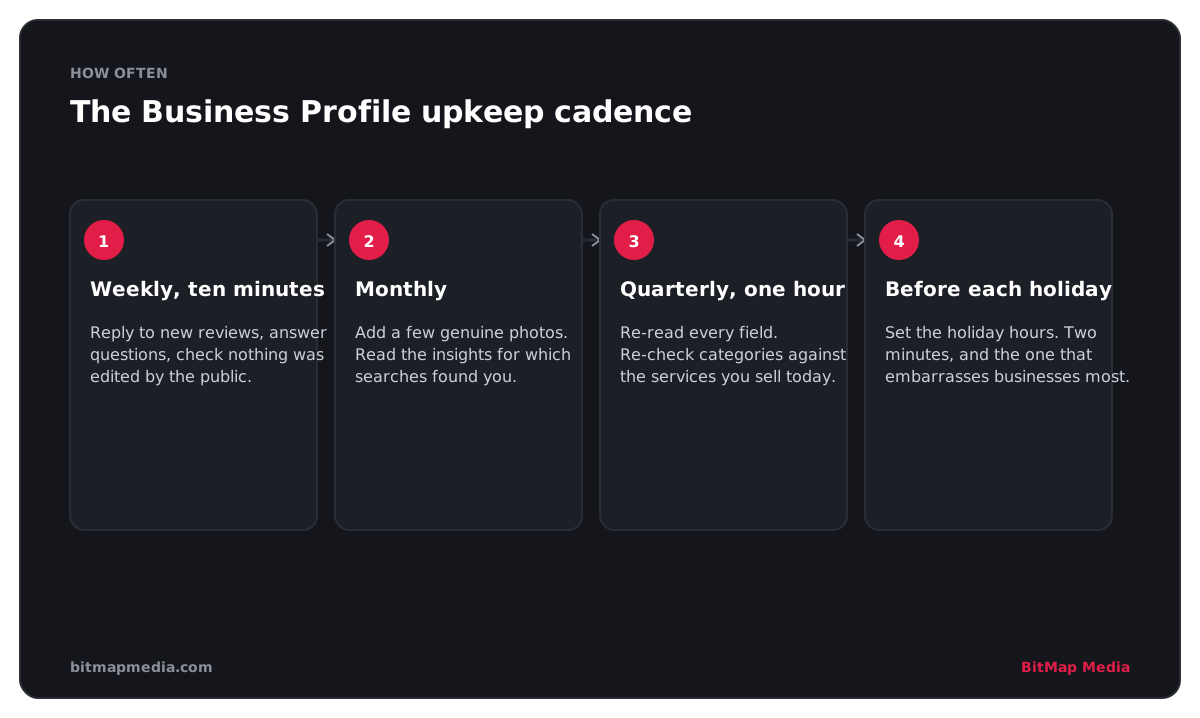
Weekly for ten minutes to reply to reviews, answer questions and check for public edits. Monthly to add genuine photos and check which searches found you. Quarterly for an hour to re-read every field and re-check categories. And before each holiday, to set the holiday hours.
- Weekly, ten minutes. Reply to new reviews, answer new questions, check nothing has been edited by a member of the public. Google accepts suggested edits from anyone, and wrong hours can sit there for months.
- Monthly. Add a few genuine photos. Check the insights for which searches found you.
- Quarterly, one hour. Re-read every field. Re-check the categories against the services you sell today, not the ones you sold when you set it up.
- Before each holiday. Set the holiday hours. It takes two minutes, and it is the one that embarrasses businesses publicly.
A Business Profile rebuild is on our One-Time Projects page at a published price, and ongoing attention is part of the monthly plan.
What are the latest Google Business Profile statistics?
Google says it drove more than 2.5 billion direct connections to US businesses every month in 2025. It removed more than 13 million fake Business Profiles that year.
Statistics last updated 10-30-2026. Each figure links to the organization that first published it.
- Google drove more than 2.5 billion direct connections a month to American businesses in 2025, including phone calls, direction requests, messages, bookings and reviews. Source: Google, 2026.
- More than 19.5 million American businesses used Google's tools to connect with customers at no cost, Google said on 05-05-2026. Source: Google, 2026.
- Google removed more than 13 million fake Business Profiles from Google Maps in 2025. Source: Google, 2026.
- Google blocked 79 million inaccurate or unverified edits to Business Profiles on Google Maps in 2025. Source: Google, 2026.
Business Profile questions
Can I change my primary category without losing rankings?
You can change it, and you should if it is wrong, but do it deliberately. Rankings move when the category moves, sometimes within days. Change one thing, write down the date, and watch for a fortnight before changing anything else.
How many secondary categories should I add?
Only ones you genuinely offer as a service. Adding categories to cover more searches is a common tactic, and it dilutes what Google thinks you are, which costs you the searches that matter most. Three accurate categories beat nine optimistic ones.
Do photos actually make a difference?
They affect whether someone picks you from the three listings, which is the part of this that converts. Real photos of your work, your vehicles and your people do more than stock images or a logo on a white background. Add them steadily, a few at a time, never fifty in one day.
What about the service area setting?
Set it to the areas you will genuinely travel to, and no further. An inflated service area does not make you rank in those places, because proximity is calculated from your actual location, and it can trigger a review of the listing.
Should I hide my address if I work from home?
If customers do not come to you, yes. Set it as a service-area business and hide the street address. Leaving a home address visible is both a privacy problem and a mismatch with the directory listings that do not show it.
What happens to my profile if I change agencies?
That depends entirely on who owns it, and this catches people out. Check now whether your own Google account holds the primary owner role on the listing. A manager role is not enough. Our guide to who owns your website covers the same question for the domain, hosting and site.

Marketers with decades across print, TV, direct mail, email, web, video and CRM. Updated 10-30-2026. About the team
Your profile is only half the picture.
The free AI Visibility Score checks the website side: whether your business name, city and phone number are stated where a machine can read them, and seven other points.
Get your Free AI Visibility ScoreRelated pages
All Knowledge Base guides
- 15 Questions to Ask Before You Hire an Agency
- AI-Ready Website: The Eight Points We Check
- Citation Signals: How AI Engines Decide Who to Cite
- Entity Pages: How a Machine Confirms Your Business
- Getting Reviews Without Gaming Them
- How to Read Your Google Search Console
- llms.txt Explained: What Is Known and What Is Hype
- Map Pack Answers: 5 Clear Wins in AI Search
- Map Pack: Relevance, Distance and Prominence Explained
- Master FAQ Page: How to Build One That Gets Quoted
- NAP Consistency: Why Small Differences Cost
- Schema for Service Businesses: The Types That Matter
- SEO, AEO, GEO and AIO Explained
- What a Website Care Plan Should Include
- Who Owns Your Website? 6 Things to Check Today
- AI Citation Kit