What a website care plan should include, and what is padding.
Most care plans list the same eight things. Two of them do nothing for you, and the two that matter most are usually absent.

Sources
Key takeaways: what a care plan should include
- What should every plan cover? Core and plugin updates applied with a way back, off-site backups that have been restored at least once, security monitoring, uptime checks, and a named amount of change time each month.
- What is usually padding? Line items with no outcome: “performance optimization” with no metric attached, “SEO monitoring” that produces no report you read, and database cleanups sold as a service.
- What is usually missing? Two things. An off-site backup that somebody has actually restored, and on-page work that changes the pages. Watching them does not count.
- What should it cost? Compare what each plan changes on the pages before you compare the monthly figure. Lower prices exist and generally buy the watching without the changing. Our own price is on the Monthly Care & SEO page.

What should be in every care plan?
Six things: core and plugin updates with a documented way back, off-site backups that have been restored as a test, security with a firewall and file-change monitoring, uptime monitoring with alerts to a human, a named amount of change time each month, and a short monthly report a non-specialist can read.
A care plan without all six is missing something that matters.
| Item | What good looks like | The question to ask |
|---|---|---|
| Core and plugin updates | Applied regularly, checked after, with a documented way back. | What happens if an update breaks the site on a Friday? |
| Backups | Off-site, automatic, retained for weeks, and restored at least once as a test. | When did you last restore one, and how long did it take? |
| Security | A firewall or scanner, file-change monitoring, hardened logins. | Who gets told first when something trips, you or me? |
| Uptime monitoring | Checks every few minutes from outside the host, with alerts to a human. | Does anyone act on the alert at 3am, or is it just logged? |
| Change time | A named number of minutes a month for edits you ask for. | What counts as change time, and what gets quoted separately? |
| Reporting | A short monthly report a non-specialist can read. | Can I see last month's for another client, with the name removed? |
What is usually padding in a care plan?
Three line items appear on most plans and rarely produce anything: performance optimization with no metric attached, database optimization sold as a monthly service, and SEO monitoring, which watches rankings move without changing anything. Each one is explained below.
Three line items appear on most plans and rarely produce anything.
Performance optimization, with no metric. Optimization towards what number, measured how? If the plan does not name a measurement, there is nothing to hold it to. We report Core Web Vitals from real user data as pass or fail, not a lab score out of a hundred, because the lab score is a diagnostic and not an outcome.
Database optimization. Worth doing occasionally, on a schedule, automatically. It is not a monthly service, and it has never been what was wrong with a site.
SEO monitoring. The word doing the work there is monitoring. Watching your rankings move is not the same as changing anything, and it is sold at the price of changing things.
A care plan padded this way costs more and does no more.
What is usually missing from a care plan?
A backup somebody has restored. Nearly every plan lists backups. Very few include a restore test, which is the only thing that proves the backup works. An untested backup is a belief, not a safeguard, and people find out which at the worst moment.
On-page work. Updates, backups and monitoring keep the site alive. None of them make it better. A plan that never changes a title, rewrites an answer, adds a question to the Master FAQ or fixes schema is a plan to stand still, and standing still on a site is a slow decline because everyone else is editing theirs.
That second gap is why our plan is one price covering care and search work together. Separating them lets the search half get cut in a quiet month, which is exactly when it should not be.
Ask any care plan provider when a backup was last restored.
How to compare two care plan quotes honestly
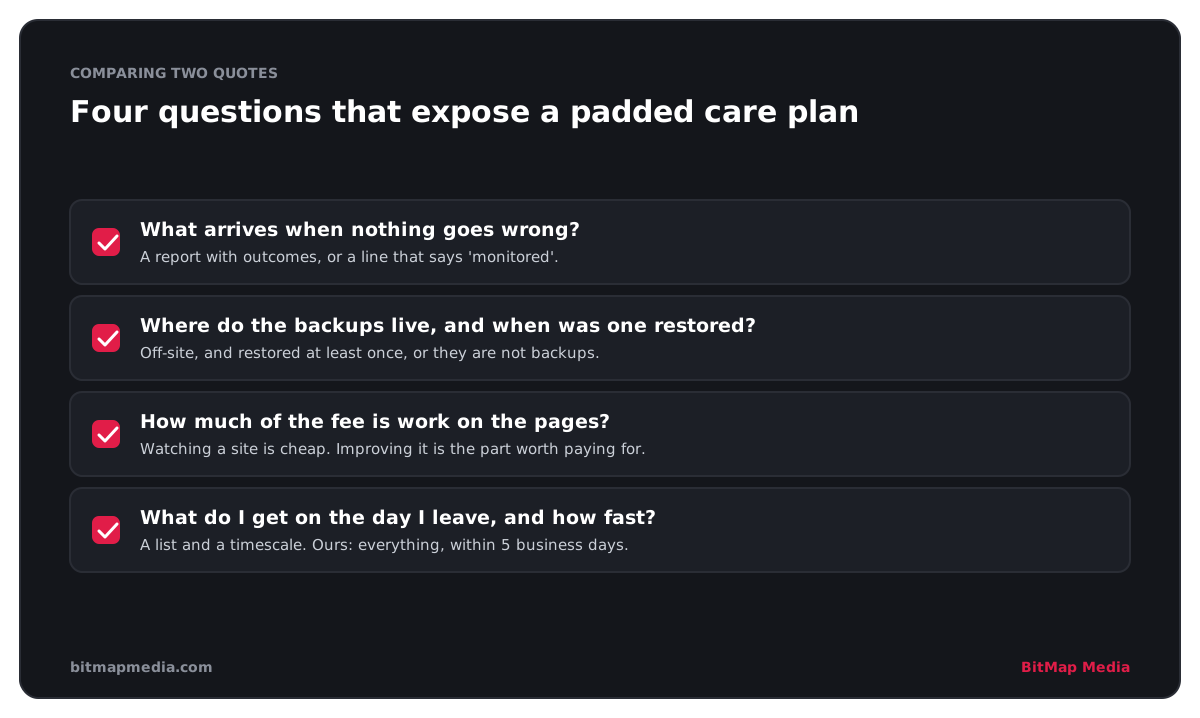
Put them side by side and ask four questions of each.
The cheaper care plan is not always the lesser one.
- What arrives at the end of a month when nothing goes wrong?
- Where do the backups live, and when was one last restored?
- How much of the fee is work on the pages, and how much is watching them?
- What do I get on the day I leave, and how long does it take?
A cheaper plan that answers all four well is a better plan. Our terms are published, so nobody has to ask for them, and the same four questions apply to us. If a quote you are comparing costs less and answers those four questions properly, take it.
Care plan questions
Is a care plan the same as the support that comes with a build?
No, and keeping them apart matters. Build support is a warranty on what was built; ours runs 30 days. A care plan is ongoing work on a live site. Anyone merging the two in a proposal is either confused or counting the warranty as a service you are paying for twice.
Do I need a plan if my site rarely changes?
The site changing is not the risk. WordPress, the theme and every plugin keep changing underneath it, and a site nobody touches for a year is the one that breaks on an update nobody was watching. The honest minimum for a static brochure site is updates, backups and monitoring.
What happens to unused hours?
In our plan they do not roll over, and we say so up front. Rolled-over hours sound generous and create an incentive to bank work instead of doing it. If you have a big month coming, tell us and we schedule it.
Can I just use my host's backups?
You can, and you should know what they actually are. Many host backups live on the same infrastructure as the site, which protects you from your own mistakes and not from the host's. The question to ask is where the backup is stored and when it was last restored.
How do I tell watching from doing?
Ask what arrives at the end of a month in which nothing broke. If the answer is a report that everything is fine, you are buying watching. If the answer is a list of pages changed and what moved, you are buying work.
What if I want to leave?
You should be able to, within a month, with everything. Ask for the exit terms in writing before you sign. Ours are published as Fair Exit: a full export of every credential, the schema files and all the content we were involved with.

Marketers with decades across print, TV, direct mail, email, web, video and CRM. Updated 10-30-2026. About the team
Before you buy a plan, find out what your site needs.
The free AI Visibility Score reports eight points measured on your live pages, so a plan can be judged against real findings from your own site, not a generic checklist.
Get your Free AI Visibility ScoreRelated pages
All Knowledge Base guides
- 15 Questions to Ask Before You Hire an Agency
- AI-Ready Website: The Eight Points We Check
- Citation Signals: How AI Engines Decide Who to Cite
- Entity Pages: How a Machine Confirms Your Business
- Getting Reviews Without Gaming Them
- Google Business Profile: The Fields That Do the Work
- How to Read Your Google Search Console
- llms.txt Explained: What Is Known and What Is Hype
- Map Pack Answers: 5 Clear Wins in AI Search
- Map Pack: Relevance, Distance and Prominence Explained
- Master FAQ Page: How to Build One That Gets Quoted
- NAP Consistency: Why Small Differences Cost
- Schema for Service Businesses: The Types That Matter
- SEO, AEO, GEO and AIO Explained
- Who Owns Your Website? 6 Things to Check Today
- AI Citation Kit