Google AI Overviews: the answer above your ranking.
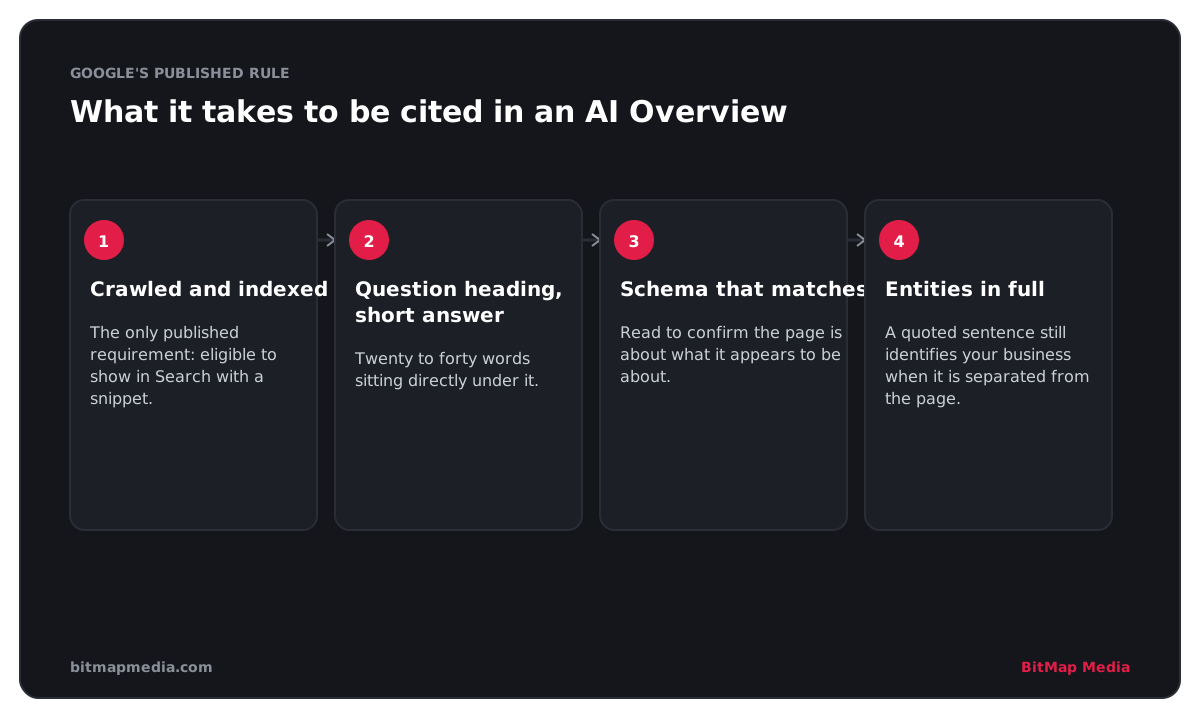
Google requires a page to be crawled, indexed and eligible to show in Search with a snippet before it can be a supporting link in an AI Overview. The foundation is the same one it always was; what changes is whether the page can be quoted.
Check your visibility free
Sources
Key takeaways
- What is an AI Overview? The AI-written answer Google now places above the organic results on many searches, with a handful of cited sources beside it.
- Who gets cited? Any page that is crawled, indexed and eligible to show in Search with a snippet. Google names no ranking position in its published requirement. Ranking work still comes first because that is how pages get found, and structure helps a page get quoted.
- Does it cost me clicks? Often yes, on informational questions. The defense is being the cited source. The tenth blue link is one nobody reaches.
- What actually changes on the page? Question headings, a twenty to forty word answer underneath each one, validated FAQ and Service schema, and facts stated in full sentences.
How does Google choose who to cite in AI Overviews?
Google's published requirement is that a page be crawled, indexed and eligible to be shown in Search with a snippet. It names no ranking position. Ranking work still comes first because ranking is how pages get found. AI Overviews favor a short answer directly under a question-shaped heading, read schema to confirm what the page is about, and personalize by location, device and history. Gemini draws on the same Google infrastructure.
- The only published requirement is that the page is crawled, indexed and eligible to show in Search with a snippet, so traditional indexing and ranking work comes first and is not optional.
- It favors a clean, short answer sitting directly under a question-shaped heading.
- It reads the schema to confirm the page is about what it appears to be about.
- It personalizes by location, device and history, so two people asking the same question may see different sources.
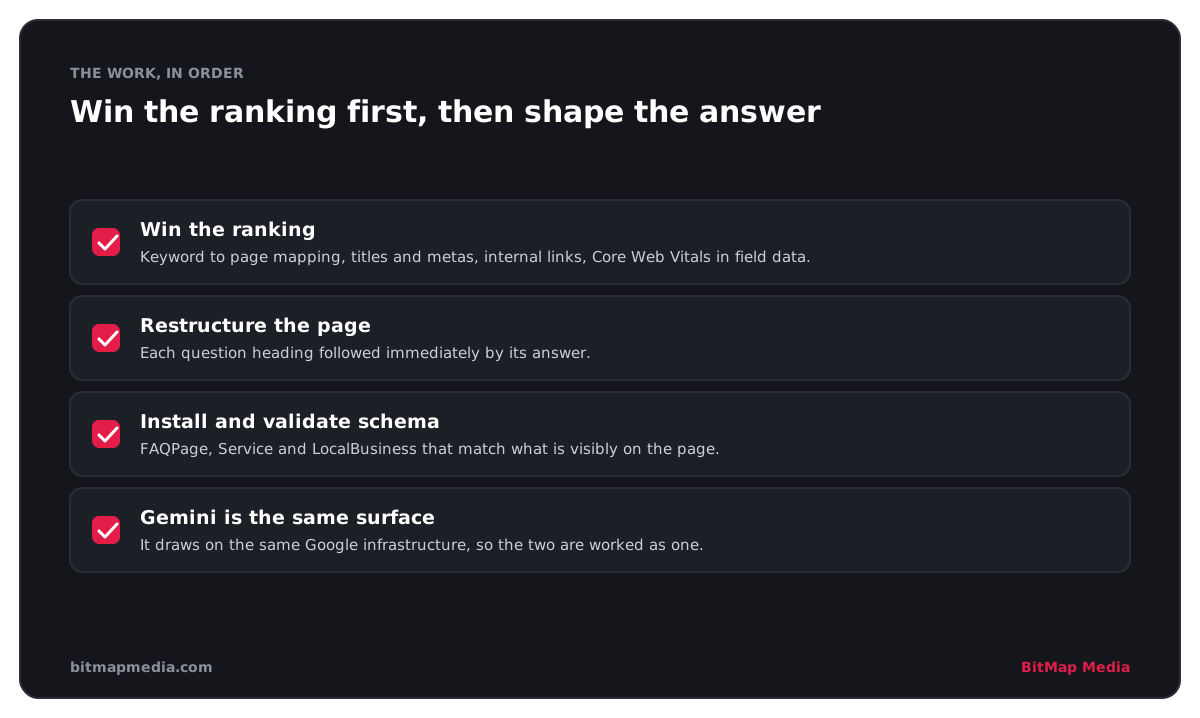
- Gemini draws on the same Google infrastructure, which is why we work the two as one surface.
What do we do about Google AI Overviews and Gemini?
Win the ranking first, restructure each page so every question heading is followed by its answer, install and validate FAQPage, Service and LocalBusiness schema that matches the page, and name entities in full.
- Win the ranking first: keyword to page mapping, titles and metas, internal links, Core Web Vitals in field data.
- Restructure the page so each question heading is followed immediately by its answer.
- Install and validate FAQPage, Service and LocalBusiness schema that matches what is visibly on the page.
- Name entities in full so a quoted sentence still identifies your business when it is separated from the page.
What are the latest Google AI Overviews statistics?
Google says AI Overviews reach more than 2.5 billion users a month. Pew Research Center found that US searchers click fewer ordinary results when an AI summary appears.
Statistics last updated 10-30-2026. Each figure links to the organization that first published it.
- Google AI Overviews have more than 2.5 billion users each month, according to Alphabet's June 2026 investor presentation. Source: Alphabet, 2026.
- Google AI Mode has passed 1 billion monthly active users, Alphabet CEO Sundar Pichai said in the company's Q2 2026 earnings remarks. Source: Alphabet, 2026.
- Google said at I/O 2026 that AI Mode queries have more than doubled every quarter since launch. Source: Google I/O, 2026.
- In a Pew Research Center study of US adults' Google searches in March 2025, 18% of searches produced an AI summary. Source: Pew Research Center, 2025.
- US adults in Pew Research Center's March 2025 study clicked a traditional search result on 8% of visits with an AI summary, compared with 15% of visits without one. Source: Pew Research Center, 2025.
- Pew Research Center's March 2025 study found US adults clicked a link inside the AI summary on just 1% of visits to pages that showed one. Source: Pew Research Center, 2025.
Google AI Overviews questions
Do I need to rank in the top ten first?
Google's published requirement is narrower than that: the page must be crawled, indexed and eligible to be shown in Search with a snippet, and it names no position. Ranking well is still how pages get retrieved in practice, so we work the ranking first.
Is an AI Overview the same as a featured snippet?
No, although the work overlaps. A featured snippet lifts text from one page. An Overview writes its own answer from several sources and cites them, which means the facts have to survive being paraphrased as well as extracted.
Can I opt out of appearing in AI Overviews?
There are crawler controls, and using them removes you from the answer as well. For most service businesses being the cited source is worth more than the text you are protecting, but it is your call, and we will lay out both sides.
Why do my results look different from my customer's?
Google personalizes by location, device and search history. That is why we measure with Search Console data and rank tracking. Our own screen proves nothing.
Does Gemini work the same way?
Close enough that we treat them as one surface. Gemini draws on the same Google infrastructure, so the ranking, structure and schema work serves both.
Is the content you publish for us checked by a person?
Yes. We keep a human in the loop on everything: AI writes the first draft, then a senior marketer checks every fact against your own material and signs the page against an eight-point content standard. Engines quote pages that are specific and correct, so the edit is what makes a page worth citing in the first place. Separately, every client site gets a 300+ point audit at onboarding and a 300+ point scan in every monthly report.

Marketers with decades across print, TV, direct mail, email, web, video and CRM. Updated 10-30-2026. About the team