Perplexity SEO: be the source it footnotes.
Perplexity shows its sources in the answer and rewards pages that are recent, structured and specific. It is the engine where a well-maintained site visibly beats a larger, staler one.
Check your visibility free
Sources
Key takeaways
- What makes Perplexity different? It footnotes its sources openly, so being cited is visible, with no inference needed, and a click actually follows more often than on other engines.
- What does it favor? Recent pages with explicit facts, clear structure and a visible updated date. Freshness carries more weight here than on most surfaces.
- Can a small site win? Yes, more readily than elsewhere. A maintained, specific page can outrank a larger competitor's stale one.
How does Perplexity choose who to cite?
It cites its sources visibly, weights recency heavily, rewards specific checkable facts over marketing language, reads question headings followed by immediate answers, and is more willing than most engines to cite a smaller site that answers the question better.
- It cites its sources visibly in the answer, so citation can be measured.
- It weights recency heavily, which is why an updated date and a real publishing cadence matter here more than elsewhere.
- It rewards specific, checkable facts over marketing language.
- It reads structure: headings that ask a question and paragraphs that answer it immediately.
- It is more willing than most engines to cite a smaller site that answers the question better.
What does our Perplexity SEO work involve?
Publishing on a steady cadence instead of in bursts, a visible and honest updated date on every page, facts that are specific and checkable, and the answer-first structure so the engine can lift a clean sentence.
- Publish on a steady cadence, with no long gaps and no bursts, so there is always something recent to reach for.
- Put a visible updated date on every page and keep it honest, refreshing the content itself, with the date following.
- Write facts that are specific and checkable: numbers, places, credentials, dates.
- Keep the answer-first structure, so the engine can lift a clean sentence.
What does a page that Perplexity can quote look like?
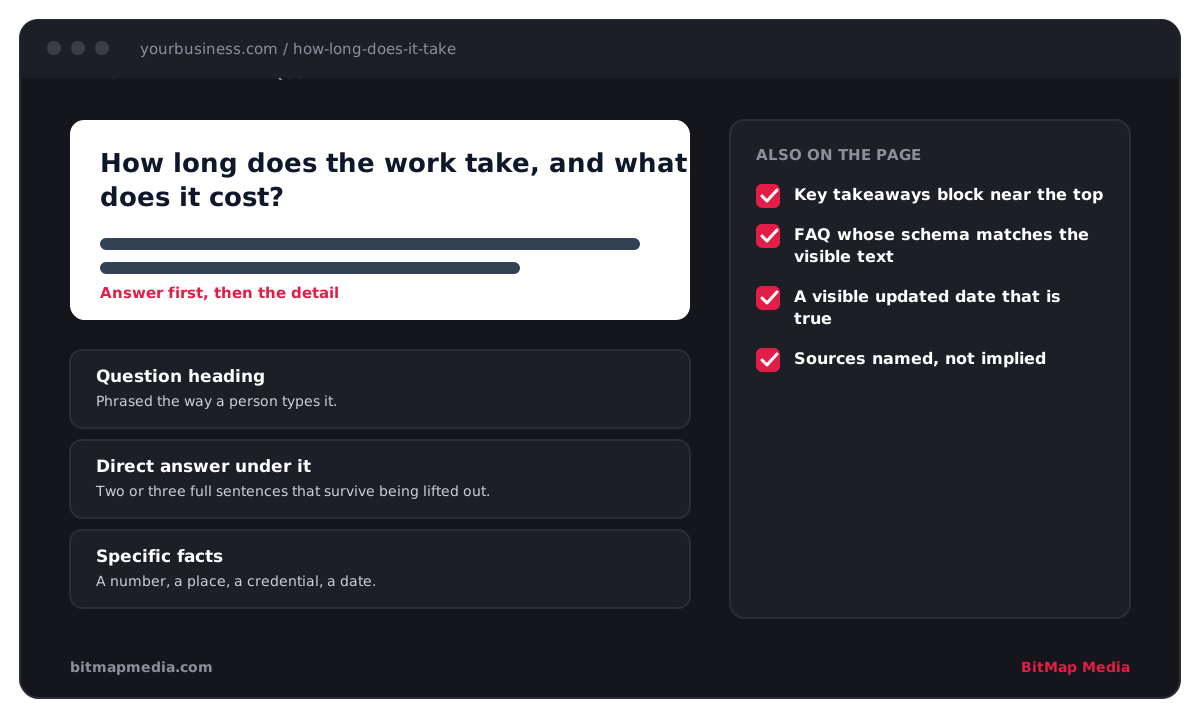
A question as the heading, a direct answer of two or three sentences right under it, a Key takeaways block near the top, an FAQ with matching FAQPage schema, and a visible updated date that is true.
- The heading asks the question the way a person types it. A service label makes a poor heading.
- The first paragraph answers it in full sentences that survive being lifted out of the page.
- Facts are specific: a number, a place, a credential, a date. "Affordable" and "trusted" give the engine nothing to quote.
- FAQ answers on the page and in the schema are the same text, so the markup never claims something a visitor cannot see.
How does Perplexity fit with your Google and Bing rankings?
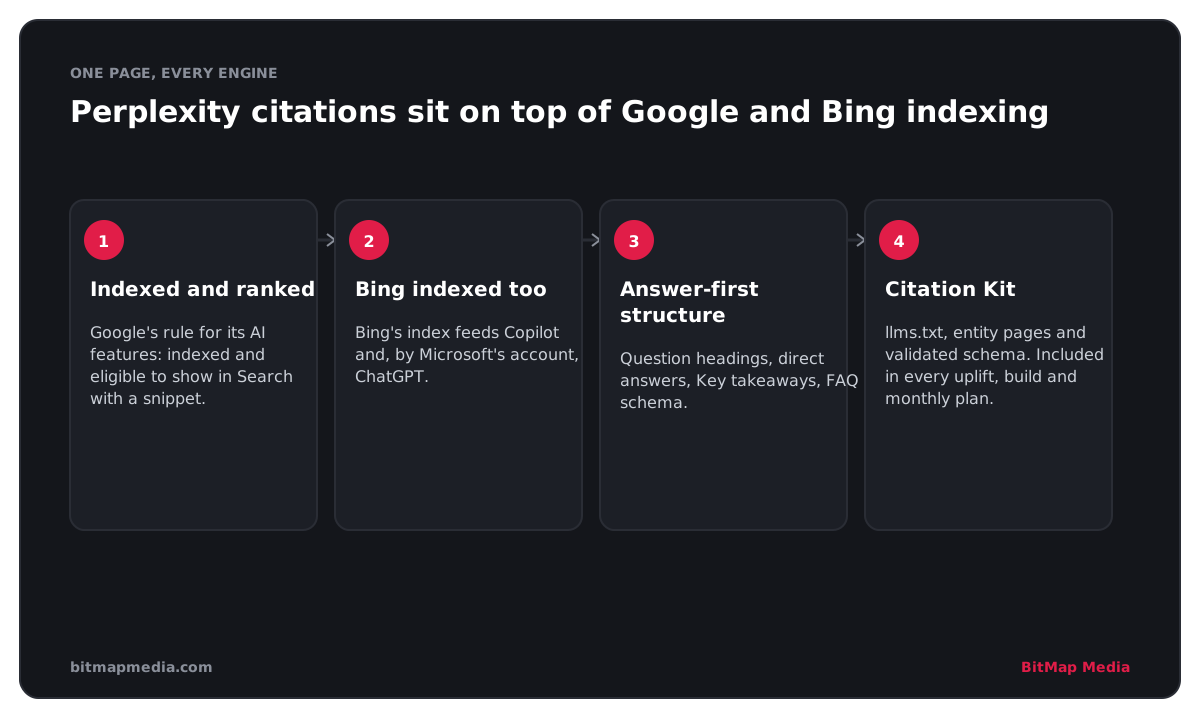
It sits on top of them. Google's published rule for appearing as a source in its AI features is that the page is indexed and eligible to show in Search with a snippet, and Bing's index feeds Copilot and, by Microsoft's own account, ChatGPT. The same page does all of that work at once.
- Classic indexing and ranking come first. A page the engines cannot find is not going to be footnoted by anyone.
- One playbook covers ChatGPT, Gemini and AI Overviews, Perplexity, Claude and Copilot. The differences are in freshness and indexing, not in what counts as a clear fact.
- The AI Citation Kit, which is llms.txt, entity pages and validated schema, is included in every uplift, every new build and the monthly plan.
- Google says crawling can take anywhere from a few days to a few weeks, so we never promise a date for a citation to appear.
What do the statistics say about Perplexity and AI answer engines?
Perplexity reported 10 million monthly users in 2023. By 2026, Pew Research Center found 42% of US adults use AI chatbots to search for information.
Statistics last updated 10-30-2026. Each figure links to the organization that first published it.
- Perplexity reported 10 million monthly active users and more than half a billion queries served in 2023. Source: Perplexity, 2023 data.
- 42% of US adults say they use AI chatbots to search for information, according to Pew Research Center's February 2026 survey. Source: Pew Research Center, 2026.
- 54% of US adults ages 18 to 29 use AI chatbots to search for information, compared with 20% of adults 65 and older, in Pew Research Center's 2026 survey. Source: Pew Research Center, 2026.
- In the GEO study by Aggarwal et al. (KDD 2024), citing sources, adding quotations and adding statistics each improved a source's visibility in generative engine answers by 30-40% on the Position-Adjusted Word Count measure. Source: Aggarwal et al., 2024.
Perplexity questions
Why does Perplexity cite small sites?
Because it is optimizing for the best answer to the question, not the biggest brand. A specific, current, well-structured page from a small business can beat a general page from a large one, which makes it the most winnable surface for most of our clients.
Does freshness really matter that much?
More than on other engines, in our experience. A page updated this quarter tends to be reached for ahead of an equivalent page from three years ago.
Should I just change the updated date?
No. Refresh the content and let the date reflect it. A date that moves while the content sits still is the kind of thing that costs trust when somebody checks.
Does a Perplexity citation actually send traffic?
More reliably than most AI surfaces, because the sources are shown as footnotes beside the answer and people click them. It is still smaller than organic search, and we report it as its own number.
Is the content you publish for us checked by a person?
Yes. We keep a human in the loop on everything: AI writes the first draft, then a senior marketer checks every fact against your own material and signs the page against an eight-point content standard. Engines quote pages that are specific and correct, so the edit is what makes a page worth citing in the first place. Separately, every client site gets a 300+ point audit at onboarding and a 300+ point scan in every monthly report.

Marketers with decades across print, TV, direct mail, email, web, video and CRM. Updated 10-30-2026. About the team